This is not an original thought with me, but it expresses just how I feel. A blogger in another forum today said, and I paraphrase, "Here I sit in Texas, worried about a senatorial election in Massachusetts, and I realize this is not the way it's supposed to be."
I feel exactly the same way. The design of the Constitution is such that a Texan should have absolutely no concern over a Massachusetts senatorial election. Even a neighboring state like New Mexico or Louisiana should not concern a Texan.
Yet today, and I write this before the outcome of the Massachusetts contest for Kennedy's throne is known, the whole nation is holding its breath over this one special election for a partial senate term. Both sides of the aisle are pulling for the win. Special interests from all over the country have been in the state pushing their side of the issue. The president of the United States has gone to Massachusetts to plead his case, and our special envoy to Haiti, the honorable William J. Clinton, last week after the earthquake in Port au Prince, flew to Massachusetts for what he saw as a greater disaster, a deeper crisis: that Ted Kennedy's heir apparent seemed to have dropped her crown.
In the original design of the constitution, states were to conduct their own business, including commerce, health care, education, et al, but somewhere -- somewhen, the monster of federalism has reared its ugly head.
It is preposterous that a Massachusetts senatorial election should send aftershocks to Texas, or for that matter, that a Texas senatorial election should send them to Massachusetts, but that is the sad state of affairs in our nation today. During the Lincoln administration, a grammatical change was imposed on our country. Before Lincoln, the correct sentence was, "The United States are..." Since that time, it has been "The United States is..."
Before, we were a union of states, unified for the purpose of mutual defense and support. We relegated such important issues as the coinage of money, the making of treaties with foreign nations, and the declaration of war to the federal government, an entity which could do nothing without the permission of the states.
Somewhere in and around the 14th Amendment, that perception changed. Now, the states are minor principalities that can do nothing without the permission and consent of the federal government.
So, we have a monstrous "health care bill," as some like to call it. It is full of pork, bribes, corruption, and under-the table deals. Both Massachusetts and Texas will have to fork over extra money -- we're talking several zeroes -- to Nebraska and Louisiana because two senators were bought for their votes. We all have to pay for the bribes.
This bill, which is now despised by both rank and file Democrats and Republicans, is being forced upon us by a beltway minority who are determined to have their way. Harry Reid is so despised in his own state that he may not survive his own party's primary, and he certainly will not survive past the November elections, and this lame duck has been put in charge of this Jabba-the-Hutt legislation.
So I sit in Texas and shouldn't even care what they do in Massachusetts, but along with sane people, both Democratic and Republican, I am concerned. We have seen what a super-majority can do on either side of the aisle, and it is not pretty.
Would it have been this way even a hundred years ago? Probably not. In 1910, each state decided how to select senators; most of them were chosen by their states' legislatures. It is safe to say that, if that were still the process, maybe 75% of the senators we have today would be doing something else. Ted Kennedy and Robert Byrd would certainly have not experienced their obscenely long terms in office.
The constitution was not meant to be this way, and it was the seventeenth amendment, passed in 1912, that diluted the purpose of the senate, turning it into a "light" version of the house, with longer terms of office.
When this election is finally decided in Massachusetts, it will heavily influence how we live in Texas, in California, in Alaska and Hawaii, and in all the other 49 states. Seriously, a senatorial election in Massachusetts should not even affect life in Maine or Connecticut.
We need a revival of the tenth amendment. States need to be allowed to do what they were intended to do. Be it prohibition, the income tax, or the fugitive slave law, every time the federal government has taken over a state issue, even with good intentions, it has only made things worse. Do we want our health care, flawed as it is, to be run by the same people who have given us the IRS, the US Postal Service, and Amtrak? Who really wants that?
I am not nearly as bothered about who might or might not win tonight in Massachusetts as I am bothered about the fact that it even concerns my way of life in Texas. It ought not to be so!
Showing posts with label Red and Blue States. Show all posts
Showing posts with label Red and Blue States. Show all posts
Tuesday, January 19, 2010


Thursday, December 3, 2009
Two Opposites Who Need Defending
The past week has not been kind to two people: President Barack Obama and former presidential candidate Mike Huckabee (I could add Tiger Woods but I prefer to only include people who work for a living and are not billionaires in this post). Though they are opposite ends of the political spectrum, both have been unjustly lambasted by the media for recent events beyond their control.
Obviously, Mr. Obama inherited two wars. I will concede that he knew when he ran for president that he would get them if he won the election. He also made some promises that anyone who is rational knew he could not keep, but we can understand that he made those promises with the naivete of one who had not yet sat in the oval office and been briefed by those who really know what's going on.
His decision this past Tuesday was a difficult one, and a valiant effort. He wants to get our troops home, but he wants them to bring victory home with them. He acknowledges that the cost is time, money, and sadly, the lives of more troops from the 30,000 that he is sending to Afghanistan. He is right that, had we concentrated on Afghanistan instead of going after Saddam (Red Herring) Hussein, we could have made a permanent difference in Afghanistan. We also need to remember that close to 500 legislators at the time thought we needed to go to Iraq, so this is not one person's "mistake," or whatever we want to call it. However, we have now been in Afghanistan twice as long as the Russians were, and we boycotted the Olympics over the Russian occupation.
We can debate the propriety of those two wars at some other time, but just or unjust, these wars were not started by the current administration, and I'm hoping that like Richard Nixon, Barack Obama can end a war he inherited. He might not like being compared to Mr. Nixon, but he has a lot in common with him. He's about to get blamed for the deaths and destruction of war, if the political cartoons of today are any indication. His popularity has declined over this, and an ABC commentator I listened to during the speech on Tuesday (I think it was Stephanopoulis, but I'm not sure), said that Obama had made this war "his war."
Obama very intelligently addressed those who call Afghanistan "another Vietnam." He presented three reasons it wasn't. First, he said, this is a response to a direct attack on our country; second, our enemies are not waging a popular war in their own country with the support of the locals, as the Viet Cong did. I would have replaced his third reason with the following: We are fighting this war with an all-volunteer armed forces.
We must never forget that in these current two wars, no one has dragged anyone out of college, job, or family and forced them to go overseas and wage an unpopular war against an unknown enemy for an ungrateful non-ally. Obama did well on Tuesday night in presenting his case, and he deserves a chance to finish what someone else started.
Unlike the war, I do think he is responsible for the economy, and he did not "inherit" our current economic situation, which is a couple of trillion dollars past the point he stepped in. But the war is another matter, and the worst thing he could have done would have been to do what he naively promised in 2008, pulling out all our troops and letting both countries figure out what to do next. Had he done that, we would not only be hated by the legitimate governments of Iraq and Afghanistan and their neighbors, but also by our NATO allies who have sacrificed time, money, and lives in what is really "our" war. I will also back up and say that he mentioned intensifying the efforts in Afghanistan while campaigning, so this should come as no surprise to anyone. Nevertheless, he did not begin this war, and unfortunately, the last administration put the Afghanistan war on a sort of "standby" for several years while our nation went after a more visible opponent. I always wondered about the Iraq thing, but was sure that our president at the time, and 400-500 legislators knew more about it than I did. Apparently, they did not.
Now we pass on to Mr. Huckabee, who has shown the hand of the media in two ways this past week. First, they have revealed how much they despise him, which is no surprise since he is way too far to the right for most of the media. The second one surprised me, though. They obviously consider him a legitimate, viable threat to win the presidency. They must, because they are pulling out the "big guns." Economically, Huckabee is very close to Ron Paul, but the media leaves him alone because they don't see him having a chance. The sad and unfortunate coffee shop murders of last Sunday are a tragedy; everyone agrees about that. But if you just read CNN, MSNBC, ABC, et al, and especially if you are just a headline reader, you would think that Huckabee walked around Arkansas with a master key, letting criminals go.
Mike Huckabee let no one go. Not even close. He commuted the sentence of a teenaged offender from 105 years to about half that, and left the rest up to the proper agency to decide who stays and who walks, a parole board. The man who killed four officers in a coffee shop had been through the revolving doors of courts and jails of at least two states, and judicial irresponsibility was the reason he was walking free last Sunday. He was free on bond after attempted child rape. Huckabee commuted the sentence of a teenager, hoping to give him a life; a Washington court let a child rapist walk free.
Huckabee noted that if the youth had been from a middle class white family, there would not have been a 105-year sentence handed out. Hey, wait a minute. Social justice! According to the media, a Republican has no business meddling with that! I've noticed that nothing has really been said about Huckabee's compassion toward a young African-American that he felt had been a victim of imbalance and injustice. In the same state, I'm sure Mr. Clinton would have been applauded for this.
It's hypocritical of the press to even bring this up. We only need to remember th 1988 Willie Horton incident. The press cried "foul" over that one. Some mindless sheep even painted it as a racist issue, though I, as one citizen, only knew Horton was a murderer who had been granted a weekend vacation. I had never seen his picture, and had no idea what color he was, even if that mattered. Dukakis had allowed Horton some "time off" from prison, and he killed someone during that time little vacation. If it was wrong for the Bush 41 campaign to make a note of this, how much more has it been wrong for the press to exaggerate the Huckabee commutation into a pardon. I saw a San Francisco Chronicle headline online this morning that said, "Huckabee Handed Out Pardons Like Candy." Not only is that irresponsible and amateur journalism (I hate to cheapen the word by using it here), it is outright vilification. By the way, I did read the article as well, and the writer had no idea what had really happened. She had read a few press clippings, less than I have read on the issue.
Huckabee has been -- and is -- a decent man, whether he is fit to be president or not. He was the most honest candidate the Republicans had to offer, and did not resort to the lowly attacks of his colleagues in both major parties. He does not deserve the slander that is being passed as "news." It's obvious that the media does not want him as president.
And on this, I agree with the media, but for entirely different reasons. I have seen what they do to presidents and candidates. I have seen the outright vilification they have even given the "darling of the media" this week, and realize now that even Obama, if he refuses to be their puppet on a string, will be crucified by the left-leaning press. I don't want to see them do it to a fellow human being like Mike Huckabee. I would like to see him continue where he is now, a public figure with the ear of a vast multitude of people, making sense out of nonsense, and always doing it like a decent human being.
A president cannot be a decent human being anymore. Our society won't let him. Mr. Obama is finding that out now. If he disappears in 2012, I fear that he will be replaced by a cold, unconcerned robot who takes marching orders from shady characters in dark rooms. That's the only type of person who can now survive a US Presidency.
Obviously, Mr. Obama inherited two wars. I will concede that he knew when he ran for president that he would get them if he won the election. He also made some promises that anyone who is rational knew he could not keep, but we can understand that he made those promises with the naivete of one who had not yet sat in the oval office and been briefed by those who really know what's going on.
His decision this past Tuesday was a difficult one, and a valiant effort. He wants to get our troops home, but he wants them to bring victory home with them. He acknowledges that the cost is time, money, and sadly, the lives of more troops from the 30,000 that he is sending to Afghanistan. He is right that, had we concentrated on Afghanistan instead of going after Saddam (Red Herring) Hussein, we could have made a permanent difference in Afghanistan. We also need to remember that close to 500 legislators at the time thought we needed to go to Iraq, so this is not one person's "mistake," or whatever we want to call it. However, we have now been in Afghanistan twice as long as the Russians were, and we boycotted the Olympics over the Russian occupation.
We can debate the propriety of those two wars at some other time, but just or unjust, these wars were not started by the current administration, and I'm hoping that like Richard Nixon, Barack Obama can end a war he inherited. He might not like being compared to Mr. Nixon, but he has a lot in common with him. He's about to get blamed for the deaths and destruction of war, if the political cartoons of today are any indication. His popularity has declined over this, and an ABC commentator I listened to during the speech on Tuesday (I think it was Stephanopoulis, but I'm not sure), said that Obama had made this war "his war."
Obama very intelligently addressed those who call Afghanistan "another Vietnam." He presented three reasons it wasn't. First, he said, this is a response to a direct attack on our country; second, our enemies are not waging a popular war in their own country with the support of the locals, as the Viet Cong did. I would have replaced his third reason with the following: We are fighting this war with an all-volunteer armed forces.
We must never forget that in these current two wars, no one has dragged anyone out of college, job, or family and forced them to go overseas and wage an unpopular war against an unknown enemy for an ungrateful non-ally. Obama did well on Tuesday night in presenting his case, and he deserves a chance to finish what someone else started.
Unlike the war, I do think he is responsible for the economy, and he did not "inherit" our current economic situation, which is a couple of trillion dollars past the point he stepped in. But the war is another matter, and the worst thing he could have done would have been to do what he naively promised in 2008, pulling out all our troops and letting both countries figure out what to do next. Had he done that, we would not only be hated by the legitimate governments of Iraq and Afghanistan and their neighbors, but also by our NATO allies who have sacrificed time, money, and lives in what is really "our" war. I will also back up and say that he mentioned intensifying the efforts in Afghanistan while campaigning, so this should come as no surprise to anyone. Nevertheless, he did not begin this war, and unfortunately, the last administration put the Afghanistan war on a sort of "standby" for several years while our nation went after a more visible opponent. I always wondered about the Iraq thing, but was sure that our president at the time, and 400-500 legislators knew more about it than I did. Apparently, they did not.
Now we pass on to Mr. Huckabee, who has shown the hand of the media in two ways this past week. First, they have revealed how much they despise him, which is no surprise since he is way too far to the right for most of the media. The second one surprised me, though. They obviously consider him a legitimate, viable threat to win the presidency. They must, because they are pulling out the "big guns." Economically, Huckabee is very close to Ron Paul, but the media leaves him alone because they don't see him having a chance. The sad and unfortunate coffee shop murders of last Sunday are a tragedy; everyone agrees about that. But if you just read CNN, MSNBC, ABC, et al, and especially if you are just a headline reader, you would think that Huckabee walked around Arkansas with a master key, letting criminals go.
Mike Huckabee let no one go. Not even close. He commuted the sentence of a teenaged offender from 105 years to about half that, and left the rest up to the proper agency to decide who stays and who walks, a parole board. The man who killed four officers in a coffee shop had been through the revolving doors of courts and jails of at least two states, and judicial irresponsibility was the reason he was walking free last Sunday. He was free on bond after attempted child rape. Huckabee commuted the sentence of a teenager, hoping to give him a life; a Washington court let a child rapist walk free.
Huckabee noted that if the youth had been from a middle class white family, there would not have been a 105-year sentence handed out. Hey, wait a minute. Social justice! According to the media, a Republican has no business meddling with that! I've noticed that nothing has really been said about Huckabee's compassion toward a young African-American that he felt had been a victim of imbalance and injustice. In the same state, I'm sure Mr. Clinton would have been applauded for this.
It's hypocritical of the press to even bring this up. We only need to remember th 1988 Willie Horton incident. The press cried "foul" over that one. Some mindless sheep even painted it as a racist issue, though I, as one citizen, only knew Horton was a murderer who had been granted a weekend vacation. I had never seen his picture, and had no idea what color he was, even if that mattered. Dukakis had allowed Horton some "time off" from prison, and he killed someone during that time little vacation. If it was wrong for the Bush 41 campaign to make a note of this, how much more has it been wrong for the press to exaggerate the Huckabee commutation into a pardon. I saw a San Francisco Chronicle headline online this morning that said, "Huckabee Handed Out Pardons Like Candy." Not only is that irresponsible and amateur journalism (I hate to cheapen the word by using it here), it is outright vilification. By the way, I did read the article as well, and the writer had no idea what had really happened. She had read a few press clippings, less than I have read on the issue.
Huckabee has been -- and is -- a decent man, whether he is fit to be president or not. He was the most honest candidate the Republicans had to offer, and did not resort to the lowly attacks of his colleagues in both major parties. He does not deserve the slander that is being passed as "news." It's obvious that the media does not want him as president.
And on this, I agree with the media, but for entirely different reasons. I have seen what they do to presidents and candidates. I have seen the outright vilification they have even given the "darling of the media" this week, and realize now that even Obama, if he refuses to be their puppet on a string, will be crucified by the left-leaning press. I don't want to see them do it to a fellow human being like Mike Huckabee. I would like to see him continue where he is now, a public figure with the ear of a vast multitude of people, making sense out of nonsense, and always doing it like a decent human being.
A president cannot be a decent human being anymore. Our society won't let him. Mr. Obama is finding that out now. If he disappears in 2012, I fear that he will be replaced by a cold, unconcerned robot who takes marching orders from shady characters in dark rooms. That's the only type of person who can now survive a US Presidency.
Wednesday, November 12, 2008
Presidential Advice from an Obscure Person
Congratulations, Mr. Obama. You made it. Anyone who could survive two long, grueling, terrible years of what has come to be known as a "campaign" deserves the benefit of the doubt and our support. My hat is off to you, and may you prosper as our president. If you have a moment, I would like to give you a few words of advice from an ordinary, run-of-the-mill type of guy. It might be some good advice, so here goes:
- Don't surround yourself with bad men. Unfortunately, that's what many of your predecessors have done. Some of them just want a way up, others want to work long enough to be able to write a book about you and make a lot of money, and then there are others with a thirst for power and a cruel streak that does not quit. I fear you've already started to do this, and it frightens me. Please understand that you don't "owe" anyone anything. You have been elected by Americans, and you have no favors to pay. So what if they gave you money or found you some votes? You owe nobody anything, except maybe to the voters who supported you.
- Find people of honor and integrity. I know that this sounds a lot like the first one, but you've already had problems. You are now the president of the United States, for crying out loud, and you can't have casual conversations any more with just anybody about anything. You had a small problem this week. Mr. Bush was ready to lay some things out, to talk in confidence, as one president to another. You did not take that confidentiality seriously, and apparently blurted a lot of it to people around you, who were all too ready to leak the details to a nosy media. In so doing, you lost Mr. Bush's confidence somewhat. No matter what you think of his politics or his ethics, you need his confidence. He's been president for nearly 8 years, and he knows things you need to know. He was ready to show you all the secret places, and you were not careful in whom you told. You cannot treat secrets that way. It was a big mistake. If you want to start well as a great president, you need to find those on your staff who blabbed to the media, fire them, and warn the others that you will do that for any other "leak."
- Don't try to save the world in one day. You will have time to get your programs in motion. If you do too much too fast, you will find that some things don't work out like you thought. There's only one group that will do you more damage than the conservatives you challenge, and that will be the liberals that you are going to have to let down. Don't promise them the moon. Ms. Speaker already thinks you are her meal ticket, and you have a wonderful power that Mr. Bush did not have: you can keep her on a short leash. If you are going to be president, you will have to do that. And while you're at it, you need to let Mr. Reid know that you are president and he is merely a senator, who before January 20 might have been your boss, but that things have changed.
- Take a long, hard look. It was easy to make promises when you were merely a junior senator. Now you will be president. You will know things we don't know, and see the world through the serious eyes of our chief executive. The presidency is the "great moderator." It swings conservatives somewhat to the left, and liberals somewhat to the right. You will need to do what Kennedy and others have done who came in from the left, and realize that the "right" is "right" about some things.
- Keep being human. It took quite a man to admit wrong in your first press conference. You inadvertently insulted Nancy Reagan. Presidents don't make offhand comments. They don't have that luxury. But your ready admission of being wrong puts you in a great light: you are willing to correct your errors and to grow. Several of those who opposed you from both major parties need to learn this lesson. They are never wrong, at least in their own eyes.
- Protect your daughters. Let them be normal. Don't make them some kind of sacrifice on the altar of political correctness by doing something silly like sending them to a public school. That is way too dangerous. They deserve a small, expensive private school. You can afford it, we the people can afford it, and only an idiot would have a problem with it. Let them be little girls, and as much as is possible, let them grow up normally. Let them share a room. Of course there's plenty of money for each of them to have one of their own, but they will need each other because you and mom, as much as you want to be, will not be there with them all the time.
- Don't listen to special interest groups. It is better to be a one-term president with integrity than a two-term president who worries about power brokers. Tell lobbyists where to get off. Don't pander to the extreme left who think they got you in. Don't feel than anyone "deserves" to be a justice, a cabinet member, or on your staff because you "owe" them. If someone reminds you that they gave you money for your campaign, give it back to them and tell them to get lost. You've got enough money to do that.
- Watch the old movie "Tick..Tick...Tick.." with Jim Brown, I think. He was a black man who won the election for sheriff in a southern town in the 1960's. Let him be a role model of integrity and how it's done. I hope you're as tired as I am of hearing the word "race" in this election. Black people make up only 14% of the American electorate, and you won something like 56% of the vote. You were not elected by a racial group, and you don't owe anything to anyone. You are not the first Black president; you are the 44th American president.
- Get the line item veto. I didn't vote for you, and I probably don't agree with many of your political issues. While it might seem counter-productive to people like me, I want to re-assert Get the line-item veto! It will kill pork, stop nonsense, and move sluggish Washington forward. The Republicans promised this in 1994, and that's why there was a landslide. Americans want their president to have a line item veto. Presidents want to have it. The only people that are against it are congressmen and senators. I'll bet you know why. GET THE LINE-ITEM VETO!
- Get in touch with Dave Ramsey. If you've never heard of him, google his name. Ask him for some advice. There is not a money machine in the basement of the White House. You do not have unlimited funds, and rich people will not have near the money that you think they do. Dave Ramsey would probably send you his book for free. He would even visit with you. His ideas could fix the hemmorhaging of money that we have seen for the last eight years. Fix that, and you might be president for life.
Mr. President, my president. I give you my support and confidence. I will stand up for you when people are talking bad about you. If I disagree with your politics or decisions, I will speak against them, but never against you. If you listen to the simple advice I gave you above, you will get my vote in 2012. You can be the greatest president this nation has ever had. Take a shot at it.
God speed, Mr. President.
Friday, May 9, 2008
In Summary: Blue and Red
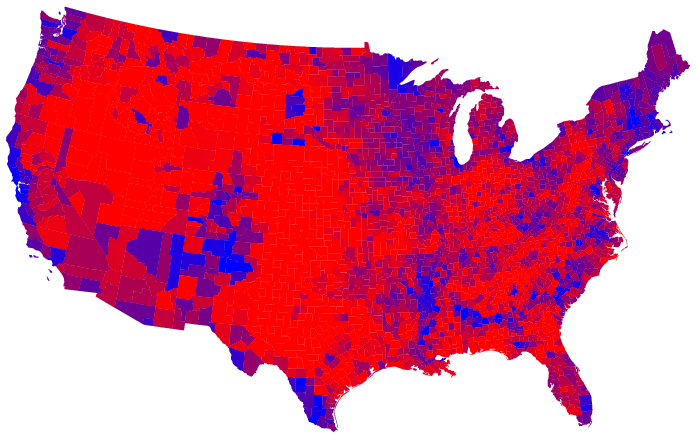
Blue states and Red states. It goes far beyond anything as simple as "Republican vs Democrat," or "Liberal vs Conservative." In a nutshell, for those who don't like to read long posts, here is the summary of the last two posts:
- Blue is a consumer; Red is a producer
- Blue wants the government to do it for him; Red wants to do it himself
- Blue likes spending others' money; Red likes saving his own
- Blue thinks things will eventually work out if he just sits there; Red wants to do something about it.
- Blue perceives comfort, entertainment, and plenty as rights; Read sees them as privileges to be earned.
- Blue thinks it's everybody else's fault when things go bad; Red thinks that bad things should be addressed and fixed.
- Blue likes to earn and spend money fast, and spend more than he makes; Red knows that the tortoise always beats the hare, and lives on less than he earns.
This also means that we have to stop voting for Santa Clause. We need to stop voting for expensive promises, and quick fixes. Maybe, this election, the best thing we could do is vote for a candidate because of what he or she will not do.
I don't care whether you vote Republican or Democrat or Third Party. I don't care whether you vote liberal or conservative. All I ask you to do this year is not vote Blue.
Monday, May 5, 2008
What do "Blue" and "Red" mean? (Part II)
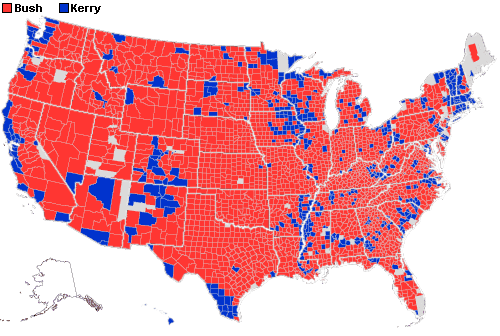
In the previous post, I noted that there had been a complete shift in the "Democratic" and "Republican" designations of the parties, which was shortly followed by the change in colors. What do the colors really mean?
While I cannot prove this, and it may be unintentional, even subliminal, the colors have a meaning that follows certain values, it appears. I risk giving everything away at the beginning of this posting, but in a nutshell, the two competing values in our nation are neither "Republican" versus "Democratic," nor "liberal" versus "conservative." The colors represent "consumer" versus "producer." The old-time "red" Democrats were farmers and factory workers, teachers and police officers. They worked to build houses and buy land, and their main desire was to do this without debt. They fed the nation, built roads and communication networks, and eventually worked to launch a human being into space.
Consumers bought up corporations in order to take their resources. They looked for ways to eat more, buy more, and spend more. Entertainment is the main venue of consumers. Once, this was the venue of the blue Republican mind set, and they relied on the red Democratic producers to feed them, clothe them, and entertain them.
While it would be easy to say that the color shift represents a similar shift in party values, that would also be over-simplification. When I look at the last two GW Bush election maps, especially the one in 2000, colored by county or precinct, I don't see Democrats vs Republicans. Mr. Bush was fortunate enough to have the support of producers in the last two elections, but I don't think the Republicans who follow him should count on that same loyalty. Not after the heavy consumer-oriented spending and legislation of 8 years of "compassionate conservativism."
What is the difference between a consumer and a producer? The best way I can describe it is to show what consumers believe. If I do that, you can figure out what the producer ideology is; simply, it's the opposite:
- Consumers think that water comes from a faucet, that eggs come twelve to a carton, and that meat is some mostly-red inanimate object that comes on a styrofoam plate, neatly wrapped in plastic.
- Consumers think that food comes from a grocery store, and that highways and utilities are an inalienable right that "someone else" needs to take care of for us.
- Consumers think that gasoline grows under service stations, for free, and that those who sell it decide how many dollars per gallon they want to take from us for it.
- Consumers do not like the dirty, nasty things that some people tell them are necessary to produce their food and fuel. They hate those who kill animals so we can eat, who plow up forests so we can grow food, and who drill wells in ice so we can drive cars.
- Consumers think that the government is a limitless source of money and resources, and has the constitutional obligation to feed us, clothe us, pay for our medical care, protect us from our own stupidity and carelessness, change our diapers when we're young, and pay for our nursing homes when we're old.
- Consumers think that we're too stupid to save money or build for our retirement, and they're willing to let the government force us into that responsibility, so they can pay us a nickel on the dollar for our investment.
- Consumers believe that money is best earned fast and spent faster. They think that the best way to wealth is to inherit it, win it in the lotto, or sue someone for it. They believe that all the woes of the world can be solved by "insurance" and "someone else's money."
- Consumers feel they are the victims of fate, and that the lucky ones have an obligation to take care of everyone else.
- Consumers feel that the highest good in life is to entertain themselves, and they spend most of their financial resources on increasing and improving that entertainment. They spend only a fraction of what they make on education, protection, and prevention, but after all, that's the "government's" job, and "it's" got plenty of money.
- Consumers are willing to outsource jobs, education, and production to places like China in order that they may be able to afford cheaper entertainment and luxury. They are willing to sacrifice quality, not only in manufactured goods, but also in government, family, and faith, in order to continue to enjoy themselves and get what they want at the cheapest price possible, down the path of least resistance.
- Consumers feel that the world revolves around them, and are not really concerned with others who might suffer if things go the way consumers want them to go in the Pollyanna world they live in.
One look at a consumer/producer map will make you erroneously conclude that there are far more producers than consumers, but that is not the case. The consumers must live close to each other and their sources of entertainment.
In our nation, we are currently divided at about 50/50%, and that is why nearly every election, court case, and legislative decision is so hotly contested and violently addressed. Where do I stand with this? If our trend continues, there will soon be less producers than consumers. When that happens, more elections and court cases will be decided by consumers. Consumers can only consume if there is someone producing. While American consumers have been the most efficient and prolific in history, there will be a breaking point. When there is, there will be violence, because consumers also believe that drastic measures are necessary to address perceived violations of rights.
Consumers just don't understand. Years ago, in the famous "Rodney King" riots, stores and markets, public services and offices, all the property of "producers," were destroyed. One of the saddest pictures of all was a line of consumers, the next weekday morning, lining up at the smoking ashes of what was formerly a post office, ready to pick up their government aid, because that was where they always got it.
There are producers and consumers in both major political parties, and they also exist among both liberals and conservatives; they know no racial nor economic boundaries. But if we are to flourish as a nation or a cultural group, we must do what we can to promote the producers, to make ways for their tribe to increase. When the "blue" begins to take over the heartlands, when it inundates the sparsely-populated counties and cities, we will all be in trouble.
Friday, May 2, 2008
What do "Blue" and "Red" mean? (Part I)
My state, Texas, has always been a "Red" state. When I was in high school, my Civics (as it was then called) teacher had a chart on the wall listing our president, senators, and representatives from each state. Texas was nearly solid red. Our governor, senators, and most of our representatives were Democrats. Why was that? Because they were farmers and laborers, soldiers and educators, all of whom believed that the most important things in America were freedom and individualism. For some reason, the Democrat color was "red." Some people used that during the Kennedy campaign to note that there was a genuine "red" threat if the Democrats won in 1960.
I remember the color of the Nixon stickers; they were the same color as the Goldwater ones later: deep blue. When did it happen -- the color shift? I suddenly realized in 2000 that the colors had traded. This was not the first, nor will it be the last, realignment. One of the biggest ones in history was the FDR revolution. Love him or hate him, FDR did something phenomenal in 1932: he switched parties, but kept his own values. Before FDR, the Democrats were the conservatives. There were no Republicans in the KKK meetings. The "solid South" was solid Democratic because they were the conservatives. The Republicans, on the other hand, were the socialist movers and shakers. Herbert Hoover was probably blamed unjustly for the Great Depression -- after all, it was a world-wide wave that caught up with America during his administration. But he had laid the groundwork for it: "A chicken in every pot." The Republicans before FDR were the ones who promised the moon and funded it with federal revenue. Republicans were the federalists who opposed states' rights.
Look it up. Republicans believed in a strong central government, in higher taxes and strong federal spending. They were the champions of social programs. Before FDR, almost all black Americans who could vote -- many were forbidden that right by southern (and northern!) Democrats, by the way -- voted Republican. Until the 60's, any Black congressional representation was Republican.
FDR changed everything overnight. He did this by taking the Republican ideals, and going further than they had in that direction. He replaced the Republican federalism with a welfare state that even the most liberal of Republicans would never have dreamed possible. The party was realigned, but not without great cost. The Democratic party would struggle with its own self-identity for nearly half a century.
The reason Harry Truman was our 33rd president is because of this struggle. Roosevelt's first choice for vice president had been powerful Texas Democrat John Nance Garner, who served under FDR for two terms -- 8 years. But Garner was an "old" style Democrat, and had problems balancing his loyalty to his constituency with serving under FDR. He was replaced in 1941 by Henry A. Wallace, from Iowa, who was then succeeded by Missouri native Truman. The truth was, it was hard to tell the players without a score card. "Democrat" meant something different in Washington from what it meant in Texas, Iowa, or Missouri. One of FDR's Texas contacts was a young Lyndon Baines Johnson, who somehow managed to stay on Roosevelt's good side in Washington while sticking close to Garner and Sam Rayburn of Texas. Johnson, for whatever else he was, knew how politics worked.
LBJ would be the architect of several impossible Senate victories. His very presence in the senate was a combination of masterful manipulation, being in the right place at the right time, and knowing how to run the seamy side of Texas Democratic politics in the 1940's. He somehow rose to the top of the Senate at breakneck speed, and did a thorough housecleaning. He knew when to ally with the enemy, and his greatest coup was his alliance with northern Republicans, with whose help he hammered out a massive civil rights bill. He was able to make strategic compromises with southern Democrats, who thought Johnson was one of them, and through their vote or their absence, engineered a bill that had his name on it and eventually led to his presidency.
In late 1963, John Kennedy had to go to Texas to try to cement the factions of the Democratic party. Johnson was supposed to guarantee Texas' electoral votes, at that time the fourth largest prize in the nation. Unfortunately, Johnson's buddies were looking at Republican Nelson Rockefeller, or even Lodge or Goldwater, as an alternative to Washington Democrats with whom they did not identify. Kennedy was not yet immortal because he had not yet been assassinated, and the tour in Texas was a desperate attempt to try to rally the troops for an election the next year that many were saying he would not win, no matter who his opponent was. From the Texas governor, down through the local representatives, Kennedy had few friends among the Democrats; the most notable was Ralph Yarborough, who didn't get along well with fellow Texas Democrats, and even refused to get anywhere near Governor Connally in the Texas motorcade. Kennedy had harsh words for Connally, who would eventually be a Republican in the continuing alignment.
Johnson's administration would do much to finally cut the last cords between pre-FDR Democrats and those who followed. He lost friends on both sides of the aisle. His support for the Vietnam war angered the new Democrats, and his social programs lost him the support of the old ones. When he decided not to run in 1968, it was because, among other things, he knew that the party was divided, and probably no Democrat, except maybe another Kennedy, could unite enough Democrats to win; in addition, he couldn't stand the Kennedy who would run.
True to form, Nixon won in 1968, mainly because the Democratic party was split between the new wave, represented by Humphrey, and the old wave of George Wallace. It would take something as serious as Watergate to get a Democrat back in the White House, and even that just barely got Jimmy Carter in. Carter was easily defeated in 1980 by Ronald Reagan, who would be the last "blue" Republican.
With Ronald Reagan as president, the re-alignment was completed. The "party of Lincoln" was now really the "party of Roosevelt." Only the names had been changed. Southern Democrats were now Republicans. Texas, Alabama, Tennessee, and others, would remain "red" states, not because they had not changed, but because the color-coding had.
I still don't know who made the decision to change the colors. Was it a subconscious recognition that the parties had changed roles in the nation? I don't pretend to believe that the Reagan Republican of the 1980's and 1990's is a carbon copy of the John Nance Garner Democrat of the 1930's, but the comparison is a lot closer than any other.
So, what's the difference? That's my subject for part II. What does it mean to be a "red" state or a "blue" state? It's not about parties, people, or politics. It's about one of the oldest social theories we can observe, but one that has rarely been put into print. I'll have more on it next week.
I remember the color of the Nixon stickers; they were the same color as the Goldwater ones later: deep blue. When did it happen -- the color shift? I suddenly realized in 2000 that the colors had traded. This was not the first, nor will it be the last, realignment. One of the biggest ones in history was the FDR revolution. Love him or hate him, FDR did something phenomenal in 1932: he switched parties, but kept his own values. Before FDR, the Democrats were the conservatives. There were no Republicans in the KKK meetings. The "solid South" was solid Democratic because they were the conservatives. The Republicans, on the other hand, were the socialist movers and shakers. Herbert Hoover was probably blamed unjustly for the Great Depression -- after all, it was a world-wide wave that caught up with America during his administration. But he had laid the groundwork for it: "A chicken in every pot." The Republicans before FDR were the ones who promised the moon and funded it with federal revenue. Republicans were the federalists who opposed states' rights.
Look it up. Republicans believed in a strong central government, in higher taxes and strong federal spending. They were the champions of social programs. Before FDR, almost all black Americans who could vote -- many were forbidden that right by southern (and northern!) Democrats, by the way -- voted Republican. Until the 60's, any Black congressional representation was Republican.
FDR changed everything overnight. He did this by taking the Republican ideals, and going further than they had in that direction. He replaced the Republican federalism with a welfare state that even the most liberal of Republicans would never have dreamed possible. The party was realigned, but not without great cost. The Democratic party would struggle with its own self-identity for nearly half a century.
The reason Harry Truman was our 33rd president is because of this struggle. Roosevelt's first choice for vice president had been powerful Texas Democrat John Nance Garner, who served under FDR for two terms -- 8 years. But Garner was an "old" style Democrat, and had problems balancing his loyalty to his constituency with serving under FDR. He was replaced in 1941 by Henry A. Wallace, from Iowa, who was then succeeded by Missouri native Truman. The truth was, it was hard to tell the players without a score card. "Democrat" meant something different in Washington from what it meant in Texas, Iowa, or Missouri. One of FDR's Texas contacts was a young Lyndon Baines Johnson, who somehow managed to stay on Roosevelt's good side in Washington while sticking close to Garner and Sam Rayburn of Texas. Johnson, for whatever else he was, knew how politics worked.
LBJ would be the architect of several impossible Senate victories. His very presence in the senate was a combination of masterful manipulation, being in the right place at the right time, and knowing how to run the seamy side of Texas Democratic politics in the 1940's. He somehow rose to the top of the Senate at breakneck speed, and did a thorough housecleaning. He knew when to ally with the enemy, and his greatest coup was his alliance with northern Republicans, with whose help he hammered out a massive civil rights bill. He was able to make strategic compromises with southern Democrats, who thought Johnson was one of them, and through their vote or their absence, engineered a bill that had his name on it and eventually led to his presidency.
In late 1963, John Kennedy had to go to Texas to try to cement the factions of the Democratic party. Johnson was supposed to guarantee Texas' electoral votes, at that time the fourth largest prize in the nation. Unfortunately, Johnson's buddies were looking at Republican Nelson Rockefeller, or even Lodge or Goldwater, as an alternative to Washington Democrats with whom they did not identify. Kennedy was not yet immortal because he had not yet been assassinated, and the tour in Texas was a desperate attempt to try to rally the troops for an election the next year that many were saying he would not win, no matter who his opponent was. From the Texas governor, down through the local representatives, Kennedy had few friends among the Democrats; the most notable was Ralph Yarborough, who didn't get along well with fellow Texas Democrats, and even refused to get anywhere near Governor Connally in the Texas motorcade. Kennedy had harsh words for Connally, who would eventually be a Republican in the continuing alignment.
Johnson's administration would do much to finally cut the last cords between pre-FDR Democrats and those who followed. He lost friends on both sides of the aisle. His support for the Vietnam war angered the new Democrats, and his social programs lost him the support of the old ones. When he decided not to run in 1968, it was because, among other things, he knew that the party was divided, and probably no Democrat, except maybe another Kennedy, could unite enough Democrats to win; in addition, he couldn't stand the Kennedy who would run.
True to form, Nixon won in 1968, mainly because the Democratic party was split between the new wave, represented by Humphrey, and the old wave of George Wallace. It would take something as serious as Watergate to get a Democrat back in the White House, and even that just barely got Jimmy Carter in. Carter was easily defeated in 1980 by Ronald Reagan, who would be the last "blue" Republican.
With Ronald Reagan as president, the re-alignment was completed. The "party of Lincoln" was now really the "party of Roosevelt." Only the names had been changed. Southern Democrats were now Republicans. Texas, Alabama, Tennessee, and others, would remain "red" states, not because they had not changed, but because the color-coding had.
I still don't know who made the decision to change the colors. Was it a subconscious recognition that the parties had changed roles in the nation? I don't pretend to believe that the Reagan Republican of the 1980's and 1990's is a carbon copy of the John Nance Garner Democrat of the 1930's, but the comparison is a lot closer than any other.
So, what's the difference? That's my subject for part II. What does it mean to be a "red" state or a "blue" state? It's not about parties, people, or politics. It's about one of the oldest social theories we can observe, but one that has rarely been put into print. I'll have more on it next week.
Subscribe to:
Posts (Atom)