Showing posts with label Presidential Campaign. Show all posts

Friday, January 15, 2010

Dropping the Ball Big-Time


I did not think it was possible to do it this fast. Oh, I knew it was possible to accomplish, but this was a speed record. In one of my earliest posts in this blog, I commented on the Republican party and the great election sweep of 1994, which was followed by a Republican president in 2001. Suddenly, this party was in the driver's seat: both houses of congress, the White House, and the prospects of three or four new Supreme Court justices.

They had a mandate including such new ideas as the "Contract with America," involfing term limits, the line item veto, and a return of tenth amendment power to the states. But what happened when they got there? It must be the swampy air of the Potomac. It seems that most people's minds lose IQ points when they get to Washington.

Fast forward to 2008. The Republicans had already lost their majorities; now they lost the White House, and gave up even more congressional and senate seats. I looked back on those fourteen Republican "golden years," and I could find nothing -- nothing -- of the "Contract with America." What we had was greed, pork, corruption, increased spending, and general incompetence. Their brightest new stars, such as J.C. Watts and Steve Largent, had disappeared earilier, seemingly disillusioned by "business as usual" politics of their own party in the Capitol cloakroom. The "pro-life" party had allowed abortion in America to increase; the "pro-family" party had stood by apathetically as radical "gay" rights groups had made violent invasions into the institutions of family, religion, education, and state.

But it took Republicans fourteen years to make a shambles of their party. Democrats will do it in two. They may be candidates for Guiness' Book of World Records. Whether I agree with their principles or not, they have failed miserably to accomplish anything at all. The war continues, and they promised it would be over. All of the special interest groups: abortion rights feminists, gays and lesbians, and government-controlled education radicals, have all been disappointed. Many now call Mr. Obama "Bush-Lite," and wonder what happened to the other people that they sent to Washington in the November sweep of 2008.

One case in point is the obscene "health care" bill, which no one has read, the majority of Americans don't want, and whose contents are being kept "top secret" by Reid and Pelosi. The bill has already cost us more than we can imagine, and if it comes to pass, the gigantic pork-filled earmarks will bankrupt our descendants four generations from now. We have watched them spend over two trillion dollars with no visible improvement to the economy, the job situation, or the general welfare of Americans. The only ones who seem to have benefited at all are those large Wall Street businesses and money-collecting banks that the Democrats told us were so evil and were in "cahoots" with Republicans.

Harry Reid's numbers are so low that even though he's from Nevada, I don't know how his own Las Vegas could give him any odds on winning. Yet he says it's all "okay." Massachusetts, where I didn't even know any Republicans lived, including Mitt Romney, the Democratic party has been seriously embarrassed. Scott Brown may not win next week, but the fact that the Democratic Party has ramped up money and publicity to try to protect "Ted Kennedy's seat" says to me that the Republicans have already won this election, even if Brown does not, by making it an actual race. Most people, conservatives included, thought it would be a coronation for Kennedy's heir apparent. The very idea that it is even close is frightening to the Democratic party, which really thought it had been given a carte blanche by American voters.

The free-wheeling spending, the abuse of power, and the wholesale breaking of promises has destroyed the faith that the electorate put in the Democratic party in 2008. Everywhere you look, you hear of "buyer's remorse," especially among independents.

America has even been disillusioned by the so-called "independents." Whether they are "blue dog" Democrats like Nebraska's Ben Nelson, pseudo-Republicans like Arlen Specter claimed to be, or self-aggrandizing fence-sitters like Joe Leiberman, we have realized that these people were not really "independent" thinkers, but people who realized their significance as "swing votes" and used that power to obtain special favors. Nelson is probably the biggest traitor with a close second being Louisiana's Mary Landrieu, who both pretended to have the interest of the nation at heart, to be fiscal conservatives and social moderates, but who, when offered literally hundreds of millions of dollars in state pork, quickly abandoned their own convictions and those of their constituencies for a bribe.

We have watched as Democratic leaders have cut special deals for special interest groups. Perhaps the most obscene is organized labor, which was rightfully incensed at the tax penalty that is proposed for those who actually have good health insurance. They were quick to back down when the Senate leadership promised them that unions would be exempt for a few years.

This Democratic session has been anything but "democratic." They have lived off the "me first" mentality that they were so fond of accusing Republicans of having in the Reagan years. What we as Americans have to look forward to is an ever-burgeoning, gigantic debt, which realistically, any economist will tell you our collected taxes can not even pay the interest on the interest of what we owe. This bill will further erode what little medical care we have in rural areas -- any district of less than 250,000 people -- and consequently will further crowd and congest the hospitals and emergency rooms of our metropolitan areas.

Republicans are gleefully clapping their hands at the gains they will make in November, but most Americans are not. Republicans will gain ground, of course, but we had a fourteen year lesson in what will happen to them. As I see the same tired, failed poster children of the last Republican takeover, Newt Gingrich being their leader, I realize that we have nothing to look forward to in this party.

The best we can hope for in current conditions is a "draw." We need a 50/50 senate, and a house with a less than ten margin either way. Such close numbers tend to deflate partisan arrogance and encourage the bipartisan cooperation that we heard Democrats boasting about so much in early 2009.

But can I close this by dreaming a little? What we really need is a purge. We need to vote out incumbents in both houses. The best way to do it, of course, would be to put third party candidates in the house and senate. I'm not talking about "independents." There is a special arrogance there, and I haven't really seen an indepentent recently who wasn't either a traitor to his former party or a boot licker to it. Some have even been both.

What we need is to elect people from identifiable third parties. The Libertarian and Constitution party come to mind, though if you are more to the left, there are others, such as the Green party that I guarantee will do more for environmental causes than any Democrat with lobby money in his pocket.

At the very least, Americans should seriously consider other political parties besides the "big two." Republicans and Democrats, in spite of all their differences, work together on one issue: keeping third parties off state ballots. Even if you don't want to vote for them, you can sign petitions, or start one, to get more parties permanently on your state's ballot. Encourage people to run for positions at all levels in these parties. The Democrats and Republicans are counting on you to ignore the other columns on the ballot. They both want "status quo," and we will never get any new, fresh ideas until we are willing to break out of the two party mold.

My dream for a better America is to wake up on a January morning where no political party has a majority, where politicians must come together and work out bills, rather than draw up obscene agreements behind locked doors. It is a dream I hope to see fulfilled in my lifetime. It is a dream that would make me supremely happy next January.

Thursday, December 3, 2009

Two Opposites Who Need Defending

The past week has not been kind to two people: President Barack Obama and former presidential candidate Mike Huckabee (I could add Tiger Woods but I prefer to only include people who work for a living and are not billionaires in this post). Though they are opposite ends of the political spectrum, both have been unjustly lambasted by the media for recent events beyond their control.

Obviously, Mr. Obama inherited two wars. I will concede that he knew when he ran for president that he would get them if he won the election. He also made some promises that anyone who is rational knew he could not keep, but we can understand that he made those promises with the naivete of one who had not yet sat in the oval office and been briefed by those who really know what's going on.

His decision this past Tuesday was a difficult one, and a valiant effort. He wants to get our troops home, but he wants them to bring victory home with them. He acknowledges that the cost is time, money, and sadly, the lives of more troops from the 30,000 that he is sending to Afghanistan. He is right that, had we concentrated on Afghanistan instead of going after Saddam (Red Herring) Hussein, we could have made a permanent difference in Afghanistan. We also need to remember that close to 500 legislators at the time thought we needed to go to Iraq, so this is not one person's "mistake," or whatever we want to call it. However, we have now been in Afghanistan twice as long as the Russians were, and we boycotted the Olympics over the Russian occupation.

We can debate the propriety of those two wars at some other time, but just or unjust, these wars were not started by the current administration, and I'm hoping that like Richard Nixon, Barack Obama can end a war he inherited. He might not like being compared to Mr. Nixon, but he has a lot in common with him. He's about to get blamed for the deaths and destruction of war, if the political cartoons of today are any indication. His popularity has declined over this, and an ABC commentator I listened to during the speech on Tuesday (I think it was Stephanopoulis, but I'm not sure), said that Obama had made this war "his war."

Obama very intelligently addressed those who call Afghanistan "another Vietnam." He presented three reasons it wasn't. First, he said, this is a response to a direct attack on our country; second, our enemies are not waging a popular war in their own country with the support of the locals, as the Viet Cong did. I would have replaced his third reason with the following: We are fighting this war with an all-volunteer armed forces.

We must never forget that in these current two wars, no one has dragged anyone out of college, job, or family and forced them to go overseas and wage an unpopular war against an unknown enemy for an ungrateful non-ally. Obama did well on Tuesday night in presenting his case, and he deserves a chance to finish what someone else started.

Unlike the war, I do think he is responsible for the economy, and he did not "inherit" our current economic situation, which is a couple of trillion dollars past the point he stepped in. But the war is another matter, and the worst thing he could have done would have been to do what he naively promised in 2008, pulling out all our troops and letting both countries figure out what to do next. Had he done that, we would not only be hated by the legitimate governments of Iraq and Afghanistan and their neighbors, but also by our NATO allies who have sacrificed time, money, and lives in what is really "our" war. I will also back up and say that he mentioned intensifying the efforts in Afghanistan while campaigning, so this should come as no surprise to anyone. Nevertheless, he did not begin this war, and unfortunately, the last administration put the Afghanistan war on a sort of "standby" for several years while our nation went after a more visible opponent. I always wondered about the Iraq thing, but was sure that our president at the time, and 400-500 legislators knew more about it than I did. Apparently, they did not.

Now we pass on to Mr. Huckabee, who has shown the hand of the media in two ways this past week. First, they have revealed how much they despise him, which is no surprise since he is way too far to the right for most of the media. The second one surprised me, though. They obviously consider him a legitimate, viable threat to win the presidency. They must, because they are pulling out the "big guns." Economically, Huckabee is very close to Ron Paul, but the media leaves him alone because they don't see him having a chance. The sad and unfortunate coffee shop murders of last Sunday are a tragedy; everyone agrees about that. But if you just read CNN, MSNBC, ABC, et al, and especially if you are just a headline reader, you would think that Huckabee walked around Arkansas with a master key, letting criminals go.

Mike Huckabee let no one go. Not even close. He commuted the sentence of a teenaged offender from 105 years to about half that, and left the rest up to the proper agency to decide who stays and who walks, a parole board. The man who killed four officers in a coffee shop had been through the revolving doors of courts and jails of at least two states, and judicial irresponsibility was the reason he was walking free last Sunday. He was free on bond after attempted child rape. Huckabee commuted the sentence of a teenager, hoping to give him a life; a Washington court let a child rapist walk free.

Huckabee noted that if the youth had been from a middle class white family, there would not have been a 105-year sentence handed out. Hey, wait a minute. Social justice! According to the media, a Republican has no business meddling with that! I've noticed that nothing has really been said about Huckabee's compassion toward a young African-American that he felt had been a victim of imbalance and injustice. In the same state, I'm sure Mr. Clinton would have been applauded for this.

It's hypocritical of the press to even bring this up. We only need to remember th 1988 Willie Horton incident. The press cried "foul" over that one. Some mindless sheep even painted it as a racist issue, though I, as one citizen, only knew Horton was a murderer who had been granted a weekend vacation. I had never seen his picture, and had no idea what color he was, even if that mattered. Dukakis had allowed Horton some "time off" from prison, and he killed someone during that time little vacation. If it was wrong for the Bush 41 campaign to make a note of this, how much more has it been wrong for the press to exaggerate the Huckabee commutation into a pardon. I saw a San Francisco Chronicle headline online this morning that said, "Huckabee Handed Out Pardons Like Candy." Not only is that irresponsible and amateur journalism (I hate to cheapen the word by using it here), it is outright vilification. By the way, I did read the article as well, and the writer had no idea what had really happened. She had read a few press clippings, less than I have read on the issue.

Huckabee has been -- and is -- a decent man, whether he is fit to be president or not. He was the most honest candidate the Republicans had to offer, and did not resort to the lowly attacks of his colleagues in both major parties. He does not deserve the slander that is being passed as "news." It's obvious that the media does not want him as president.

And on this, I agree with the media, but for entirely different reasons. I have seen what they do to presidents and candidates. I have seen the outright vilification they have even given the "darling of the media" this week, and realize now that even Obama, if he refuses to be their puppet on a string, will be crucified by the left-leaning press. I don't want to see them do it to a fellow human being like Mike Huckabee. I would like to see him continue where he is now, a public figure with the ear of a vast multitude of people, making sense out of nonsense, and always doing it like a decent human being.

A president cannot be a decent human being anymore. Our society won't let him. Mr. Obama is finding that out now. If he disappears in 2012, I fear that he will be replaced by a cold, unconcerned robot who takes marching orders from shady characters in dark rooms. That's the only type of person who can now survive a US Presidency.

Tuesday, September 22, 2009

A Dose of Decency

Recently the news has been filled with reports of something that can only be described as “people being rude.” Whether it’s a tennis star threatening to do horrible things to a line judge, a slightly drunken performer stealing the microphone at an awards banquet, or a United States congressman shouting “You lie!” at the president, we can’t assume this all just happened overnight.

Why do people in the public light seem to have so little respect for each other? We’ve been leading up to this for years. Like the Roman arenas of two millennia ago, we seen to enjoy gathering together and watching people get ripped apart; this time, however, it is not by lions, but by other people.

TV talk shows of the 70’s and 80’s have evolved into slugfests on camera. People throw chairs and issue death threats, all the time listening as the audience cheers them on. Any checkout line at any major market is littered with racks full of juicy “gossip,” most of it false, reporting the illnesses, failures and faults of our celebrities. Somebody must be buying this or it wouldn’t continue to be there.

Rules of decency and decorum, it seems, are for other people. They are for the “other” political party, the rest of the world, for “ordinary” people, not people like me. “You see,” we rationalize,” I had the right to do what I did. I don’t care what anybody else thinks.

Maybe we all need to go back to kindergarten. The teacher used to tell the children, “If you say something bad about someone, I will require you to follow it with three good things about that person.” I once knew of an organization that, in their planning sessions, required someone to say three positive things about someone’s idea before trying to “shoot it down.”

It appears that “positive” just doesn’t sell. People would rather see someone “voted off the island” or verbally butchered on a stage in front of a hostile audience during a morning talk show. Many of us feed on this, and then wonder why that person behind us in the checkout line was so rude to us.

Our rudeness is bleeding over into real life. In one city, a man slaps a woman’s child for crying in the supermarket. In another city, a minister says he’s praying for the president to get sick and die. Elsewhere, a teacher gives her students a writing assignment that involves such violence and abuse that it is better not to print the subject in this newspaper. And lest we forget, it was only a few years ago that the press praised a movie in which President George W. Bush was assassinated. The movie even won awards. In my own humble opinion, that's just a little more serious than "You lie!" though neither one should be praised. It seems that no institution is immune from this virus that is spreading through our culture.

It’s time for a dose of decency. Maybe the “sane” ones in our culture need to take the lead. If you’re one of those people, it can start by not honking or tailgating someone that cuts us off in traffic, or by letting the rude customer go ahead of us in line; after all, neither of those things really cost us any time or money. Maybe it’s not letting our kids hear us verbally abuse those people on the TV screen. It’s time to make an intentional effort to be decent. No one really wants a return to the days of the Roman Circus Maximus. Let’s think before we talk. Maybe we can even set an example for those athletes, stars, and national leaders who are supposed to be setting an example for us.

Thursday, December 18, 2008

The Sinatra Syndrome

For eight years I have heard the left talk about "diversity" and "inclusion." They have spoken of how the Bush Administration and the political Right have excluded some people because of a philosophical difference. With yesterday's announcement of Rick Warren as the one to lead the invocation at the inauguration, I have finally found out the what the Left means when it says "diverse" or "inclusive." It means "I'll have it my way." The Frank Sinatra song was playing in my head as I went to bed last night, and I couldn't shake it.

Mr. Obama has been surprisingly inclusive in his selection of administration. In fact, if I had to mention just one word that has been characteristic of this transition time, it would be "gracious." He has not entered Washington as a conqueror, but as another servant in a long line of succession of public servants. However, I am pleased to see that Mr. Obama knows that he's no one's lap dog. Nancy Pelosi and Harry Reid, with all their partisan bitterness and rudeness, have implied that they have great plans for him, and he is consistently reminding them that, come January 20, he will be their boss.

Late in the evening of November 4, cities across the world looked like the cities that win super bowls. People were dancing in the streets. Why? They were anticipating a grand new age: the dismantling of everything that the Bush administration stood for. On January 21, they thought, the cargo planes would pull all the military out of Iraq. All those filthy rich people would lose all those horrible tax exemptions, and the money would be automatically deposited in the accounts of the deserving poor. Billions of dollars would be released to abort babies of poor innocent women, and the stem cells of those feti would be harvested and all known diseases in the world would be cured. Gay people would be celebrating marriage in court houses and liberal churches in all 50 states, and any of those rustic old churches that did not allow the ceremony would be padlocked or burned to the ground.

In early February, after picking an "inclusive" jury, the war crimes trials were going to begin for Bush, Cheney, Rice, and others, with Colin Powell getting immunity for turning states' evidence. Then they would all be sent to an international court somewhere for life imprisonment.

The only unemployed people, after January 20, would be right wing fundamentalist ministers, conservative talk radio hosts, and Republican lawmakers.

Rick Warren is not a right wing fundamentalist minister. Most Southern Baptists, of which he is one (though his church does not include the word in its name), would consider him "left-leaning." Understand, however, that those "fundamentalist" Southern Baptists are far more tolerant of alternate people and views than the Left. Rick Warren is a fiscal moderate and would probably come closer to the views of mainstream Democrats and moderate Republicans in the area of medical care, government backing of social programs, and funding for research. His church has raised millions of dollars to combat AIDS worldwide. He believes that both the government and the church have a responsibility to help the poor, and is an environmental advocate and supports measures to reduce global warming, something that probably would not be said of most Southern Baptist ministers.

Mr. Warren no longer accepts a salary from his church; in fact, he has even paid back all the salary they have paid him since he started the church in the 80's. Like J.C. Penney of another era, the Warren family are "reverse tithers." They keep 10% of their earnings and give the other 90% to their church and to charitable causes. He has not gotten his money from tearful begging sessions on cable TV, but through the writing of well-researched books that people have actually wanted to buy. He is not a "money grubber" by any means, and desires no national stage or world wide recognition.

Mr. Warren hosted the first tête à tête between the two major candidates, on the stage of his own church, asking them the same questions, endorsing neither, and affirming both. It was not the first time Mr. Obama has appeared at his church, having spoken there before he was a serious candidate for president, on an issue that he and Warren have in common: AIDS eradication. There was no outspoken criticism of Rick Warren from that "fundamentalist right" for these moderate, inclusive views. We must face the truth: whether we like right-wingers or not, they are far more tolerant than their angry counterparts on the left.

If nothing else, Rick Warren is the best possible choice to lead the invocation at the Inauguration. He represents the best of both worlds. He is a man of faith and integrity as well as a man of conscience. Unfortunately for the Left, the man has a genuine, non-political conscience, something that radical leftists lack. He feels that the unborn are an oppressed group, just like the Jews of the Holocaust, and the American slaves of past centuries.

Now Katheryn Kolbert, of the so-called "People for the American Way" has the audacity to say that Mr. Obama should have selected a minister who represents the "mainstream" of America to open the Inauguration. I can think of no other way to say it, except that maybe that was the most ignorant statement I have heard since the election. She said this because Rick Warren recommended that Californians vote for an amendment to undo the damage that judges had done to the concept of marriage in California. Gays and lesbians represent 2% of Americans, and many of their own group feel that gay marriages are unnatural and uncalled for. Yet the clueless Ms. Kolbert thinks her views are "mainstream."

Abortion is and always has been a hot-button issue. When the US Supreme Court hijacked America's wishes in 1973 and by a 5-4 vote decided that it was right to kill babies after all, and that states had no say in the matter, and that taxpayers had to pay for it, regardless of their own conscience, over 70% of Americans were opposed to abortion. Even after 35 years of this murder being imposed on us, over half of Americans are against it. Yet a pro-life pastor is considered outside the "mainstream."

When gays and lesbians began their repugnant crusade to be recognized as a minority group, and invaded the civil rights issues that rightly belonged to racially displaced Americans, their battle cry was "it's not the government's business what goes on in the privacy of our own bedrooms." It would be a very hypocritical cry. Most of us did not want to look in their bedrooms. We had -- and have -- absolutely no interest in their bedrooms. We're tired of seeing them march in streets, tired of having to watch them kiss while in the movie theaters, both on the screen and in the seats in front of us. We're tired of them forcing their way into churches and civic clubs, trespassing and disrupting orderly meetings, violating the constitutional right of freedom to assemble.

The gay and lesbian movement has not been in the bedroom. If it had been, there wouldn't be propositions like the state wide ones that all passed on election night, 2008, while Democrats were making historic gains in races all across the country. If anything shows how out of touch the Liberal Left is, it is that the party closest to their views, which voted in near-record numbers, did not help out their radical agenda.

I fear a disruption of the inauguration by this vocal 2% and less. You see, they lied about diversity. They lied about inclusion. They care about neither; all they care about is the violent imposition of their narrow views on the vast majority of decent Americans. Mr. Obama chose the person he felt most qualified to lead the prayer at his inauguration (since his likely first choice, Billy Graham, at 90 years old, is now too feeble for such events). Mr. Warren is a minister who is faithful to the text that he has studied and practiced most of his life. He is supportive of his friend, the President-elect. His inaugural prayer will be neither the first nor the last prayer he offers for Mr. Obama.

Evan Wolfson, founder of the group Freedom to Marry, said "Rick Warren did a real disservice to gay families in California and across the country by casually supporting our continued exclusion from marriage. I hope in the spirit of the new era that’s dawning, he will open his heart and speak to all Americans about inclusion and our country’s commitment to equality.”

I hope that in the genuine spirit of the new era that's dawning, Mr. Wolfson and others will find the intelligence to live by his own words, and realize that it's absolutely none of his business whom the President-elect chooses to lead the opening prayer at his inauguration.

The far left has shown its true colors. Some have said that Obama was the most liberal senator we have had since his election. That may or may not be true. Hypothetically, if it is true, we need to realize the chilling fact that the most liberal of all 100 senators is still not liberal enough for the radical left.

I am pleased that Mr. Obama has been his own man so far. I'm sure I will not like all the decisions he makes as president, but he has impressed me so far by showing that he will not kowtow to anyone. He's president, and that's what it's about.

And to the leftist radicals -- the Loud-mouthed Left -- I have one message. If you want it "your way," either visit a Burger King or go buy a Sinatra CD.

Wednesday, November 12, 2008

Presidential Advice from an Obscure Person

Congratulations, Mr. Obama. You made it. Anyone who could survive two long, grueling, terrible years of what has come to be known as a "campaign" deserves the benefit of the doubt and our support. My hat is off to you, and may you prosper as our president. If you have a moment, I would like to give you a few words of advice from an ordinary, run-of-the-mill type of guy. It might be some good advice, so here goes:

  1. Don't surround yourself with bad men. Unfortunately, that's what many of your predecessors have done. Some of them just want a way up, others want to work long enough to be able to write a book about you and make a lot of money, and then there are others with a thirst for power and a cruel streak that does not quit. I fear you've already started to do this, and it frightens me. Please understand that you don't "owe" anyone anything. You have been elected by Americans, and you have no favors to pay. So what if they gave you money or found you some votes? You owe nobody anything, except maybe to the voters who supported you.
  2. Find people of honor and integrity. I know that this sounds a lot like the first one, but you've already had problems. You are now the president of the United States, for crying out loud, and you can't have casual conversations any more with just anybody about anything. You had a small problem this week. Mr. Bush was ready to lay some things out, to talk in confidence, as one president to another. You did not take that confidentiality seriously, and apparently blurted a lot of it to people around you, who were all too ready to leak the details to a nosy media. In so doing, you lost Mr. Bush's confidence somewhat. No matter what you think of his politics or his ethics, you need his confidence. He's been president for nearly 8 years, and he knows things you need to know. He was ready to show you all the secret places, and you were not careful in whom you told. You cannot treat secrets that way. It was a big mistake. If you want to start well as a great president, you need to find those on your staff who blabbed to the media, fire them, and warn the others that you will do that for any other "leak."
  3. Don't try to save the world in one day. You will have time to get your programs in motion. If you do too much too fast, you will find that some things don't work out like you thought. There's only one group that will do you more damage than the conservatives you challenge, and that will be the liberals that you are going to have to let down. Don't promise them the moon. Ms. Speaker already thinks you are her meal ticket, and you have a wonderful power that Mr. Bush did not have: you can keep her on a short leash. If you are going to be president, you will have to do that. And while you're at it, you need to let Mr. Reid know that you are president and he is merely a senator, who before January 20 might have been your boss, but that things have changed.
  4. Take a long, hard look. It was easy to make promises when you were merely a junior senator. Now you will be president. You will know things we don't know, and see the world through the serious eyes of our chief executive. The presidency is the "great moderator." It swings conservatives somewhat to the left, and liberals somewhat to the right. You will need to do what Kennedy and others have done who came in from the left, and realize that the "right" is "right" about some things.
  5. Keep being human. It took quite a man to admit wrong in your first press conference. You inadvertently insulted Nancy Reagan. Presidents don't make offhand comments. They don't have that luxury. But your ready admission of being wrong puts you in a great light: you are willing to correct your errors and to grow. Several of those who opposed you from both major parties need to learn this lesson. They are never wrong, at least in their own eyes.
  6. Protect your daughters. Let them be normal. Don't make them some kind of sacrifice on the altar of political correctness by doing something silly like sending them to a public school. That is way too dangerous. They deserve a small, expensive private school. You can afford it, we the people can afford it, and only an idiot would have a problem with it. Let them be little girls, and as much as is possible, let them grow up normally. Let them share a room. Of course there's plenty of money for each of them to have one of their own, but they will need each other because you and mom, as much as you want to be, will not be there with them all the time.
  7. Don't listen to special interest groups. It is better to be a one-term president with integrity than a two-term president who worries about power brokers. Tell lobbyists where to get off. Don't pander to the extreme left who think they got you in. Don't feel than anyone "deserves" to be a justice, a cabinet member, or on your staff because you "owe" them. If someone reminds you that they gave you money for your campaign, give it back to them and tell them to get lost. You've got enough money to do that.
  8. Watch the old movie "Tick..Tick...Tick.." with Jim Brown, I think. He was a black man who won the election for sheriff in a southern town in the 1960's. Let him be a role model of integrity and how it's done. I hope you're as tired as I am of hearing the word "race" in this election. Black people make up only 14% of the American electorate, and you won something like 56% of the vote. You were not elected by a racial group, and you don't owe anything to anyone. You are not the first Black president; you are the 44th American president.
  9. Get the line item veto. I didn't vote for you, and I probably don't agree with many of your political issues. While it might seem counter-productive to people like me, I want to re-assert Get the line-item veto! It will kill pork, stop nonsense, and move sluggish Washington forward. The Republicans promised this in 1994, and that's why there was a landslide. Americans want their president to have a line item veto. Presidents want to have it. The only people that are against it are congressmen and senators. I'll bet you know why. GET THE LINE-ITEM VETO!
  10. Get in touch with Dave Ramsey. If you've never heard of him, google his name. Ask him for some advice. There is not a money machine in the basement of the White House. You do not have unlimited funds, and rich people will not have near the money that you think they do. Dave Ramsey would probably send you his book for free. He would even visit with you. His ideas could fix the hemmorhaging of money that we have seen for the last eight years. Fix that, and you might be president for life.

Mr. President, my president. I give you my support and confidence. I will stand up for you when people are talking bad about you. If I disagree with your politics or decisions, I will speak against them, but never against you. If you listen to the simple advice I gave you above, you will get my vote in 2012. You can be the greatest president this nation has ever had. Take a shot at it.

God speed, Mr. President.

Monday, September 29, 2008

The Most Expensive Campaign Ever

What do you think constitutes too much money to spend to campaign? How many millions? Do we get into the billions territory? This past week has seen the most expensive of all; in fact, today it reached over a trillion dollars. As stocks fell, and people wondered if their banks would be open the next morning, Democrats and Republicans saw this multibillion dollar fiasco as a chance to do some political jousting.

I watched as the situation built to critical mass. John McCain "suspended" a dying campaign so he could devote time to this crucial situation on behalf of America. This was spoken by a man who ranks last in the Senate this year -- for time spent in the Senate. Barack Obama came and sat in the White House and pretended he knew what was going on as he listened to economic advisers discuss what the next step would be.

A shiver runs down my spine as I realize that neither one of these men, and one will be president, has a clue about anything financial. However, they both have seen it as an excellent political opportunity.

Congress found out today that it's "kind of" important to listen to the electorate. Americans simply don't want to put our grandchildren further in debt to bail out irresponsible Wall Street sharks. We just don't have much in common with banks -- the tallest buildings in our towns, the ones that own our houses and cars and replaced knees and hips. However, we do have a lot in common with our friends and neighbors who are putting "for sale" signs in their front yards, and we don't see how 700 billion dollars sent to Wall Street is going to do anything about that.

But it's quite a photo op. The bill might have passed today if Nancy Pelosi had not made such a fool of herself. Perhaps the only poorer taste in campaigning I have ever seen was in 2002 when Democratic operatives tried to turn the late Senator Paul Wellstone's funeral into a campaign rally.

Pelosi gave us a prime example of why Congress's approval rating makes George Bush look like a rock star. They can get nothing done. Her rather crass grilling of the party across the aisle -- and a Democrat who has a few brain cells, and there are several, knows that the mess we are in is "bi-partisan" -- cost her any semblance of leadership.

But Nancy, I'm thankful. I'm like most Americans. I know that my retirement funds will be back. And one reason for that may be that your congress was not able to print 700 thousand thousand thousand dollar bills.

Having something like this happen so close to an election has been a mixed blessing. Those in the highest echelons of power are obviously not interested in what is happening to us. They are seeing this as a chance for a political move, a way to turn the elections in their favor. On the other hand, some savvy politicians and observers saw this as an opportunity to remind 435 people in the lower chamber that their jobs are on the line. Talk show host Dave Ramsey even encouraged us to call our congressional offices and tell them we would fire them if they voted for this measure. I think Dave must have a pretty good listener base. I think they called.

Pelosi was surprised. Bush was surprised. Republican leaders who were supposed to deliver the votes to GW were surprised. Harry Reid was near tears. John McCain and Barack Obama were almost speechless (that's a perk there). I thought that the evening network news anchors were going to cry on the air. A rather smug George Stephanopoulos assured us that this "necessary" bill would be passed as soon as those silly Republicans took a step back, got over their mad, and re-voted on this issue.

I'm counting on them holding their ground. I've been hearing Mr. Obama say that McCain and others are just extensions of George W. Bush and his "failed policies." Today, those same Republicans are the reason that the largest Socialist trap ever conceived in our nation did not become a reality. It was the Democrats who wanted to continue Bush's policies.

My own local congressman, a Republican, canceled a speech at our local high school to get back to DC in time to vote, and he voted against the Bailout. He's got my vote, and he would have it no matter what party he was in.

How much did this campaigning cost us? Seven hundred billion is cheap. The stock market lost a couple of trillion dollars today. That money came out of our 401k's, our educational savings plans, our teachers' retirement funds, and our personal mutual funds. It happened because government got involved in economics. If cooler heads had prevailed, and we had decided to ride this crisis out for a while and let those grasshoppers die while the ants weathered the winter, we would have seen a hiccup in the market today.

We can also thank the media, who have decided that we are about to go through a great depression worse than 1929, and are warning us about it on every corner. This is the same media that caused race riots in their irresponsible coverage of Rodney King, who showed us how bad we are for not bailing out a New Orleans that had built a city below sea level. They are the ones who continually have to remind me who's black and who's white when I want to look beyond color.

All in all, the loud ones were in a minority today. I'm sorry, GW, Nancy, Harry, John, and Barack. You are not getting our money to play with today. If you want to help us out with 700 billion dollars, I suggest you just give it back to us! We know what to do with it. Better than you do, obviously. I know you won't because there's not much to campaign about when responsible people use their own money to create business, growth, and prosperity.

We will survive. Even a trillion dollar loss will not stop those of us who avoid debt, who spend only what we make and try to give away as much as we can. We are not going to give you our money. Don't even think about it.

Oh, and a big PS that I can't put anywhere else. You want to know how messed up our congress is? Here's the title of what they voted on today. Notice there is nothing about Wall Street, bailouts, interest rates, or anything else. Most normal human beings would have given it a name that was germane to the vote. See if you can figure this one out; I am not making this up. This is the title of the bill that was voted on today:

To Amend the Internal Revenue Code of 1986 to Provide Earnings Assistance and Tax Relief to Members of the Uniformed Services, Volunteer Firefighters, and Peace Corps Volunteers, and for Other Purposes

And you wonder why they never get anything done.

Tuesday, July 29, 2008

Sorry, but I'm Not Sorry!

Thank you, US congress. In the midst of the morass you have made of things in the last two years, you're still getting your priorities upside down. You may actually set a record: most "non-binding" resolutions in history. When the Democrats won power in both houses of congress in 2006, those who support the Left saw it as a moral victory. Surely Pelosi, Reid and company would usher in a new world order, complete with looser abortion laws, greater inroads for homosexuals, and gigantic increases in government spending, financed by more taxes on those evil rich people who seem to make money, no matter what we do.

Instead of doing any of these things, Congress has continued to play the "non-binding resolution" game. They've passed resolutions against the war, against Bush, in favor of his indictment, against Republicans, against apple pie, and against hot dogs. Well, most of those things anyway. Now, they are set for a pivotal moment in history: they are poised to offer a non-binding apology for slavery! This is the stuff that single-digit approval ratings are made of!

Please indulge me. It's not that I'm in favor of slavery or anything. I'd like to think that if I had been a wealthy Connecticut land owner in 1788, I would have opted not to have slaves. But the bottom line is, I don't owe anyone an apology. I'm not responsible for my Saxon ancestors who brutally overran the agrarian Celts before the first millennium was over. I'm not responsible for anything they did, even if they are my great X 10 grandparents.

If I had a time machine, I might try to go back and find my ggg grandparents, and tell them to let their slaves go. Maybe I could help them get to the underground railroad, and follow the Drinking Gourd into Canada. Maybe I could have been Harriet Tubman's right-hand man. But the truth of the matter is, what's done is done, and I can do nothing about it.

If it had even been closer. If my own father or grandfather had kept slaves, I might feel an obligation to apologize. I might even want to sell what I own and help pay reparations, especially if some of those slaves or their children were still alive. But that's not happened.

All slaves and slave holders have been dead for generations. There are no slaves left to apologize to, and no slave owners to make the apology. When any major group, be it social, religious, or political, seeks to make an apology on my behalf, I get a little ticked. But now, congress, which has done nothing but twiddle its thumbs, has decided to issue an apology for slavery.

Don't get me wrong. I'm sorry for slavery. I'm sorry for the way our forefathers ripped valuable land away from the Indians and took it for themselves. But there are differing types of "I'm sorry." Sometimes, we intentionally hurt someone. We rob from them, or do bodily harm, or spread malicious gossip about them. Or we may just lie to them. In that case, we say "I'm sorry," which can be translated as "Please forgive me." Then, there's the moment when we are getting to our seats in a crowded theater and accidentally step on someone's toe, or we momentarily block the view of "Coming Attractions." In that case, we say "I'm sorry," and what we mean is "Excuse me." Then, there is that moment when one of our friends comes to us and tells us of the discovery of an illness that will require surgery, or of the loss of a beloved pet or family member. When we hear that, we say "I'm sorry," and that could probably best be interpreted as "I sympathize with you."

I cannot figure out what level of "I'm sorry" congress seems to be trying to use. If it's "Please forgive me," I can't join in. I've never had slaves, never been in favor of slavery, and have absolutely no control over my ancestors, of whom there may not have been slave holders anyway. After all, there never were that many slave holders in America. Even in that evil, slave-owning Confederacy, over 80% of the soldiers that died fighting for states' rights had never owned a slave, and had no plans to. So I can't figure out any reason to truthfully say "Please forgive me." I did nothing wrong. And neither did you, unless you are reading this, are over 150 years old, and were in the top 10 per cent of the socioeconomic class of the US when you were young.

If it's "excuse me," I can't join in. I haven't even accidentally had slaves. I'm rather timid, and have a problem even telling my children to run an errand for me. I don't think I've stepped on too many toes, literally or figuratively, but have found that, when I do, as in these editorials I write, I really don't want to say "excuse me," because I don't want to be excused. All the toes I step on are on purpose, and none of them has had anything to do with slavery.

If it's "I sympathize with you," I can't go there either. If I found a genuine former slave, someone who had the scars of cuffs on his wrist, or of lashes on his back, I would be able to show compassion and sympathy for what he had gone through. But I think all those people are dead. In what I believe theologically, they are in a state of eternal bliss at this moment, and even if they could hear the "I'm sorry" from congress -- on YOUR behalf, by the way, it would mean nothing to them.

I think that, as long as we're in the non-binding resolution business, I would like to propose one to my own congressman, if he's listening. How about a "Let bygones be bygones" resolution? Let's realize that the past, however evil it was, cannot be changed, and that often, it is in the midst of a series of evil things that good things are brought about. As I think of how many Americans of African descent have contributed to our culture, of how pleased I am to know personally many people of African descent, I'm willing to forget the endless procession of time and circumstance that has brought about what got them here. For all I know, I myself may be a product of slavery -- some tiny event in history may have spurred the conception of a now-remote ancestor. And I know for sure that I'm a product of the taking of lands from the American Indians. I have the blood of at least two tribes coursing through my own veins. So I really didn't need Senator Brownback's apology to us, er, them recently. What's done is done.

At a time of record low approval ratings -- just in case you're interested, Bush is 3 times as popular as congress, and even Dick Cheney is twice as popular -- maybe congress is looking for any friends it can find. But remember, potential friends of congress. This resolution will be "non-binding." And it will do about as much good as it would do to dig up your great-great-great-great grandfather's grave and chew him out for maybe having slaves.

Let the healing begin.

Saturday, June 14, 2008

You Can't Have It Both Ways

Presidential Candidate Obama was "incensed" this week. A little earlier, he had angrily told a TV audience, "when they go after me, I can handle it; but my wife is off limits." There are some moments when I might sympathize with him, but not this time.

The old saying is, "If you can't stand the heat, get out of the kitchen." Obama has done what many other candidates have done -- recruited family members as part of the campaign. There is a line that needs to be drawn. Traditionally, the candidate had the adoring wife and children around him. The wife, if the candidate was elected, adopted some politically neutral causes like hunger or literacy.

I don't know if it started with the Clinton campaign -- I'm sure it didn't -- but Hillary made it an issue. She was vocal and extremely opinionated, and assumed the the office of First Lady was more than ceremonial. As a result, she was sometimes berated or criticized. And for some reason, Bill thought that wasn't fair.

Nobody ever criticized Mamie Eisenhower. In spite of the bitter dislike that many had for Richard Nixon, Pat Nixon was left alone. Even Laura Bush is still respected. She doesn't suffer from the angry political rhetoric that Michelle Obama is already seeing. Why? Because Laura Bush has not been used by her husband as a political tool.

Look at what Obama was saying this week, in effect: "I'm going to use my wife for political mileage. She will speak out on issues that I'm most passionate about. She will speak against those who oppose us, and challenge the Republican policies that are in place. She will have a carte blanche to say whatever she wants, but if anyone says anything against her, that is unfair, and they will have to deal with my righteous indignation."

Sorry, Mr. Obama. It doesn't work that way. There is no political "king's X." You have the choice of letting her be your adoring wife, or putting her on the front lines, in the trenches. If you do the latter, expect people to snipe at her.

And Obama is not the only one to do this. He's just the latest. But the whole issue is a silly political game that many candidates are playing. Remember Martha Mitchell, the loudmouth wife of the Watergate era? It can happen to anyone, at any time.

I'm not telling Michelle Obama that she needs to stay home, making tea and cookies. She may have some good ideas, and she may want to proclaim them. All I'm saying is, if she wants to climb up on the public podium, don't expect to be treated like a happy homemaker.

She may be our next first lady, and as such, should be respected. But if she's going to talk a lot, she should expect her words to be analyzed. She seems to be erudite and professional, and I recommend that she express her views boldly and openly. We might learn something, whether we agree with her or not.

But please don't feign wide-eyed surprise when someone responds.

Wednesday, May 14, 2008

The Myth of "Popular Vote"


I know I've covered this before, but people keep bringing it up. A recent CNN website poll asked us how the Democratic candidate should best be chosen -- by delegates or popular vote. Overwhelmingly, the respondents picked "popular vote."

We have lived with this myth now for well over 100 years: that somehow, "popular vote" gets us the best candidate. It only takes a review of history to realize that some of our best presidents were not elected by popular vote. As I look at our three apparent front-runners for the US presidency, I have to ask, "Is this really the best we can do?" Somehow, I do not think I am the lone voice on this issue.

Is McCain really the best that the Republican party can do? Most Republicans don't seem to think so, yet McCain was elected by popular vote. He got a little help from the Guiliani states -- the ones that Rudy "gerrymandered" before the primaries began -- the idiotic "winner take all" idea that robs delegates of any true representative power. If popular vote gets the candidate the people want most, why aren't Republicans out en masse singing McCain's praises? Simply because popular vote does not work.

I see all the enthusiastic rallies for the two Democratic contenders. I see the ridiculous logic of women interviewed every night, "I'm voting for Hillary because she's a woman!" What in-depth thought! What intelligent analysis of the needs of our republic! "She has two X chromosomes, so I'm going to vote for her." That's popular vote speaking. We could say the same things about Obama. He deserves to be considered because of his record, his preparation, his convictions, his philosophies. Yet his candidacy is reduced each evening to a simple trait: his color. I hear Martin Luther King spinning in his grave. More than ever, we are judging people not by the "content of their character," but rather by the color of their skin or the number of x and y chromosomes they have.

When I was in high school, the cheerleaders were elected by popular vote. They would all come to an assembly of the rest of us, and perform their "try-outs," and then we would go to our classrooms and vote. While we were voting, I can never recall anyone commenting on athletic ability, on being able to say the right things to get the game crowd "in the spirit." I did hear things like "she's cute," or "she stole so-and-so's boyfriend." The cheerleader vote was a beauty contest, an analysis of trite things. No one took the ability to lead cheers into account. That's probably okay with high schools. No one is taking it that seriously anway. In the rare moments that they do, we get some macabre story of a woman hiring a hit man to "take out" another cheerleader candidate's mother. We don't want it to be serious.

But I think we do when we consider who will try to be our executive leader for the next four years. The last thing we need is a "popular vote" based on skin color, gender, or ability to convince enough voters that a candidate will do all the right things and push the right buttons.

Delegates are not perfect by any means, but they at least have a chance to seriously look at issues and make an informed choice. In times past, candidates have been elected in local precincts because people thought they were someone else. In the 70's, when I was a devout Republican, I once thought I was voting for George Bush (future 41) to be my local representative to the US house. After all, that's what it said on the ballot. I was surprised later to learn that I had voted for his kid, who was just in his twenties. What a dirty trick.

Some people don't even vote for a candidate. The lazy way is to just check the box at the top, and vote for a party. That may have even worked in times past, but it means nothing now. There are good candidates for local elections in both parties, and it is a horrible thing to avoid one of them because someone tows a party line rather than showing the diligence to see who the candidates really are.

Most people don't know enough to vote anyway. I've voted ignorantly many times, and often, couldn't even remember who I voted for later.

Popular elections don't get the best people in place. Rembember 1972? The Nixon landslide? Love him or hate him, Nixon could not be called the "people's choice." He won because of the popular vote. Was he the best they had to offer at that point? I don't know. Many think he wasn't.

In 1976, I have problems believing that the Georgia peanut farmer was the best the Democrats could do. It was almost a "gimmee" election -- running against an unelected president who had replaced an indicted and resigned one. And Carter nearly lost anyway. Why? Can you say "popular vote primaries?"

What the Democrats need this year is a good delegate fight. I'm not talking about those superdelegates -- which is just a distribution of slot machine tokens to the war horses of the party. I'm talking about real human beings who do more than mark a ballot -- who hammer out issues, and determine party and platform policy. I would love to see Democrats come together for their national convention and go through the nightmare of a deadlock, to see them have to hammer out several agreements, and finally emerge with a dark horse candidate that didn't even spend the last 18 useless months kissing babies, drinking beer, and bowling. Maybe someone who was actually voting in the Senate or House during that time, or sitting in with the pundits determining policy. Someone who really knows what's going on -- whose spouse is not saying things that need to be explained away, or whose daughter is not saying "none of your business" to people who ask questions.

The Republicans need one of these types of conventions this year, too, but that's a pipe dream. They will have a coronation. The platform and policies will already be set, and there will be posturing and moving and shaking as the post-Bush Republican party hands out the cushy jobs and people move up in the shuffle. And McCain may or may not win, but it won't matter.

Both major parties are scared to death to do anything that the Founding Fathers intended in order to get a leader. They are also scared to do what their party founders sought in getting a candidate nominated.

We are condemned to mediocrity. Popular elections are possibly the worst way to choose a leader. Drawing straws might actually be better. Remember that some of the popularly elected leaders we have seen recently were named Hussein, Castro, and Chavez. Popular elections do not produce the kind of bold, wise leadership that our nation and others need.

That's why the Framers of the US Constitution were against them.

Friday, May 9, 2008

In Summary: Blue and Red


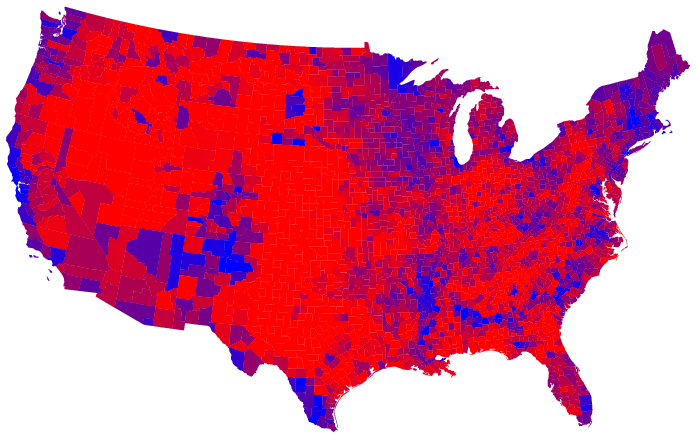
Blue states and Red states. It goes far beyond anything as simple as "Republican vs Democrat," or "Liberal vs Conservative." In a nutshell, for those who don't like to read long posts, here is the summary of the last two posts:

  • Blue is a consumer; Red is a producer
  • Blue wants the government to do it for him; Red wants to do it himself
  • Blue likes spending others' money; Red likes saving his own
  • Blue thinks things will eventually work out if he just sits there; Red wants to do something about it.
  • Blue perceives comfort, entertainment, and plenty as rights; Read sees them as privileges to be earned.
  • Blue thinks it's everybody else's fault when things go bad; Red thinks that bad things should be addressed and fixed.
  • Blue likes to earn and spend money fast, and spend more than he makes; Red knows that the tortoise always beats the hare, and lives on less than he earns.
Again, "Red" is not Republican; in fact, Republicans are looking bluer and bluer each year. The two main parties will be a choice, not of color, but of shades of blue. I look forward to the return of a viable "Red" candidate. Some of you have local "Red" candidates, for senator, representative, governor, and local offices. The higher you climb, the less red you will see. We must support "Red" candidates locally, and send a message to the top.

This also means that we have to stop voting for Santa Clause. We need to stop voting for expensive promises, and quick fixes. Maybe, this election, the best thing we could do is vote for a candidate because of what he or she will not do.

I don't care whether you vote Republican or Democrat or Third Party. I don't care whether you vote liberal or conservative. All I ask you to do this year is not vote Blue.

Friday, May 2, 2008

What do "Blue" and "Red" mean? (Part I)

My state, Texas, has always been a "Red" state. When I was in high school, my Civics (as it was then called) teacher had a chart on the wall listing our president, senators, and representatives from each state. Texas was nearly solid red. Our governor, senators, and most of our representatives were Democrats. Why was that? Because they were farmers and laborers, soldiers and educators, all of whom believed that the most important things in America were freedom and individualism. For some reason, the Democrat color was "red." Some people used that during the Kennedy campaign to note that there was a genuine "red" threat if the Democrats won in 1960.

I remember the color of the Nixon stickers; they were the same color as the Goldwater ones later: deep blue. When did it happen -- the color shift? I suddenly realized in 2000 that the colors had traded. This was not the first, nor will it be the last, realignment. One of the biggest ones in history was the FDR revolution. Love him or hate him, FDR did something phenomenal in 1932: he switched parties, but kept his own values. Before FDR, the Democrats were the conservatives. There were no Republicans in the KKK meetings. The "solid South" was solid Democratic because they were the conservatives. The Republicans, on the other hand, were the socialist movers and shakers. Herbert Hoover was probably blamed unjustly for the Great Depression -- after all, it was a world-wide wave that caught up with America during his administration. But he had laid the groundwork for it: "A chicken in every pot." The Republicans before FDR were the ones who promised the moon and funded it with federal revenue. Republicans were the federalists who opposed states' rights.

Look it up. Republicans believed in a strong central government, in higher taxes and strong federal spending. They were the champions of social programs. Before FDR, almost all black Americans who could vote -- many were forbidden that right by southern (and northern!) Democrats, by the way -- voted Republican. Until the 60's, any Black congressional representation was Republican.

FDR changed everything overnight. He did this by taking the Republican ideals, and going further than they had in that direction. He replaced the Republican federalism with a welfare state that even the most liberal of Republicans would never have dreamed possible. The party was realigned, but not without great cost. The Democratic party would struggle with its own self-identity for nearly half a century.

The reason Harry Truman was our 33rd president is because of this struggle. Roosevelt's first choice for vice president had been powerful Texas Democrat John Nance Garner, who served under FDR for two terms -- 8 years. But Garner was an "old" style Democrat, and had problems balancing his loyalty to his constituency with serving under FDR. He was replaced in 1941 by Henry A. Wallace, from Iowa, who was then succeeded by Missouri native Truman. The truth was, it was hard to tell the players without a score card. "Democrat" meant something different in Washington from what it meant in Texas, Iowa, or Missouri. One of FDR's Texas contacts was a young Lyndon Baines Johnson, who somehow managed to stay on Roosevelt's good side in Washington while sticking close to Garner and Sam Rayburn of Texas. Johnson, for whatever else he was, knew how politics worked.

LBJ would be the architect of several impossible Senate victories. His very presence in the senate was a combination of masterful manipulation, being in the right place at the right time, and knowing how to run the seamy side of Texas Democratic politics in the 1940's. He somehow rose to the top of the Senate at breakneck speed, and did a thorough housecleaning. He knew when to ally with the enemy, and his greatest coup was his alliance with northern Republicans, with whose help he hammered out a massive civil rights bill. He was able to make strategic compromises with southern Democrats, who thought Johnson was one of them, and through their vote or their absence, engineered a bill that had his name on it and eventually led to his presidency.

In late 1963, John Kennedy had to go to Texas to try to cement the factions of the Democratic party. Johnson was supposed to guarantee Texas' electoral votes, at that time the fourth largest prize in the nation. Unfortunately, Johnson's buddies were looking at Republican Nelson Rockefeller, or even Lodge or Goldwater, as an alternative to Washington Democrats with whom they did not identify. Kennedy was not yet immortal because he had not yet been assassinated, and the tour in Texas was a desperate attempt to try to rally the troops for an election the next year that many were saying he would not win, no matter who his opponent was. From the Texas governor, down through the local representatives, Kennedy had few friends among the Democrats; the most notable was Ralph Yarborough, who didn't get along well with fellow Texas Democrats, and even refused to get anywhere near Governor Connally in the Texas motorcade. Kennedy had harsh words for Connally, who would eventually be a Republican in the continuing alignment.

Johnson's administration would do much to finally cut the last cords between pre-FDR Democrats and those who followed. He lost friends on both sides of the aisle. His support for the Vietnam war angered the new Democrats, and his social programs lost him the support of the old ones. When he decided not to run in 1968, it was because, among other things, he knew that the party was divided, and probably no Democrat, except maybe another Kennedy, could unite enough Democrats to win; in addition, he couldn't stand the Kennedy who would run.

True to form, Nixon won in 1968, mainly because the Democratic party was split between the new wave, represented by Humphrey, and the old wave of George Wallace. It would take something as serious as Watergate to get a Democrat back in the White House, and even that just barely got Jimmy Carter in. Carter was easily defeated in 1980 by Ronald Reagan, who would be the last "blue" Republican.

With Ronald Reagan as president, the re-alignment was completed. The "party of Lincoln" was now really the "party of Roosevelt." Only the names had been changed. Southern Democrats were now Republicans. Texas, Alabama, Tennessee, and others, would remain "red" states, not because they had not changed, but because the color-coding had.

I still don't know who made the decision to change the colors. Was it a subconscious recognition that the parties had changed roles in the nation? I don't pretend to believe that the Reagan Republican of the 1980's and 1990's is a carbon copy of the John Nance Garner Democrat of the 1930's, but the comparison is a lot closer than any other.

So, what's the difference? That's my subject for part II. What does it mean to be a "red" state or a "blue" state? It's not about parties, people, or politics. It's about one of the oldest social theories we can observe, but one that has rarely been put into print. I'll have more on it next week.

Tuesday, March 11, 2008

Sleep Deprivation without Representation


It was fun for me when I was a little kid. It meant an extra hour of baseball with my friends on the vacant lot near my house, or on the dirt road down the street. It did seem strange, though, for there still to be glimmers of light at nearly ten o'clock.

Some things changed, for sure. We once had three or four "drive-in" movie theaters. My home town still has one, amazingly, but they died throughout the great Southwest. And I remember the security I felt in the order of our elementary school classrooms. That clock on the wall was controlled in the principal's office. He could change it, and we often saw the reset happening before our very eyes. You could count on that clock. It would buzz once for things like recess or lunch, and three times for a fire drill. It was never wrong. The clocks were placed back-to-back on adjoining walls in the orderly elementary school I attended, and I dreaded the years that the clock was on the wall facing us, instead of comfortably behind us. That minute hand would climb from six back up to twelve with an agonizing slowness.

Then, one year, those clocks didn't work any more. They had been designed for a time and place where the sun determined the hour. They had never been designed to be run backwards one hour in the fall, or for that matter, even run forwards one hour in the spring. That magic button the in principal's office (probably near the famed "electric paddle") was not equipped to handle the intricacies of Daylight Savings Time. In another year, half the clocks (there were about 40 on the campus, all controlled by the same button), no longer kept good time. Some were hours off, and even the ones that were close were not that reliable. We had to depend on our watches, and the bells and buzzers were irregular. Somewhere along the way, they were replaced by a tone that came over the speaker system. Even the fire drill was no longer three exciting buzzes. It was a "fire tone" on the speaker.

Town clocks were broken as well. They had never been intended for this abuse. And that says nothing of our internal clocks. People, in what should have been the rush of spring, were coming to work angry and moody, feeling the loss of an hour of sleep. Pets were puzzled by the change in feeding time, and pre-schoolers could not go to sleep in their cribs when the sun was shining through their windows.

Children stood in the dark, waiting for school buses. In the spring, people showed up for church just as the final prayer was being announced, and then in the fall, the habitually late got to services in time to help the sexton open the doors.

No one has ever been able to reasonably explain why 48 of our states do this every year. Oh, I know what you're saying: "to save energy." I believe that like I believe the Internal Revenue Service has the purpose of raising money for the operation of government. Some studies this year have even noted that the new, earlier move to "spring forward" may actually be conterproductive and waste more energy in the morning than it purportedly saves in the evening. We have even heard that the rationale for the longer DST is based on surveys and studies from the 70's, fully a generation ago, that have no bearing at all on current work patterns and personal preferences.

So why did this happen? Was there a great public outcry for DST? While I'm sure there's the occasional "odd man out" that says "I like it," most Americans are offended, irritated, and perplexed by it. Most who don't speak against it simply tolerate it.

What amazes me the most is that the people who imposed this -- thing -- on the American public are the very ones we have sent to represent us in congress. No one wants it, so why do those who claim to represent us keep voting for it? Why do the "farm" advocates of the midwest vote with the "cubicle" candidates of the big cities? It makes no sense.

And my biggest question: "Why do we keep sending these people back to Washington?" If this really is a "representative democracy" (which the Constitution never claims, by the way), why do these things keep happening? At the turn of the last century, the Supreme Court overruled the "income tax" as unconstitutional. It took an amendment to make it legal. That meant that congress actually had to propose it and vote for it, then that 2/3 of all the state legislatures had to approve it. Was there really a public outcry in America at the time? "Tax us, tax us!" Did that happen, or did some people in high places disregard the welfare of their own electorate when they made April 15 a dark day?

Ask any ten Americans about DST, and 7-8 will say, "Get rid of it." Yet congress keeps expanding and protecting it (they managed to get Indiana "on board" a year or two ago).

The more "democracy" we get, it seems the less results we get. The "majority rules" idea seems to destroy what most Americans want. As I see the remaining candidates left for the presidential election, I see a Republican that no one is really too excited about. I see Democrats who are scared to say it too loud, but who whisper to themselves, "Are these two clowns really the best we could do?"

Why do we keep sending these people to Washington, and to our state capitals? And what can be done about it? I wish I knew. For now, I know that most people are still rubbing sleep out of their eyes this week, and just about the time we get used to it, they will change it back so they can confuse us all over again.

And we keep voting for these people.

Thursday, February 28, 2008

Do They Really Think I'm That Stupid?

First of all, let me say that, unless I have some type of epiphany myself, I will not vote for John McCain. There is a 94% chance that the name I check in November has not yet even been announced. So this is not a McCain campaign ad, nor one for anyone else that you see every night on national news.

This, rather, is about an American institution's self-redefinement (I just invented a word, I think). Once, the Press was in the business of informing us. Remember Walter Cronkite signing off every evening, "And that's the way it is..." It might not have been, but everyone still thought that was the purpose of the Press back then.

Somehow, in the past 30 years, the Press has decided that, instead of reporting the news, it is supposed to create news. I will quickly clarify that a free American Press has always been in the middle of history. Thomas Nast was able to topple some big and corrupt officials with his journalism -- and sometimes, it was just pictures. There is nothing as important as having someone "on the spot" to tell us what is actually going on. Sometimes, that clarification, that truth, is what actually makes history.

That is the reason the First Amendment protects a free and uncontrolled Press. That's why I keep capitalizing "Press" as I write this. It is a valid and necessary institution, and that is why the framers of the Constitution provided for its protection, along with some other necessary institutions in the First Amendment.

Then there's the New York Times. I think their motto is, "We make our own news so we don't have to look for any." Take a recent and now-well-known scenario. Some time in this long, boring, ineffective, drawn-out thing that some people say resembles a presidential campaign, the NYT decided to endorse some candidates. One was John McCain. Everyone probably knows that when the NYT endorses a Republican, it's really saying "This one would do the least damage to our own ideology." No one expects them to really like the candidate, and that was true with McCain, and everybody knew it; not only that, no one really had a problem with it. Most Republicans would rather not get a NYT endorsement anyway. It's kind of like being endorsed by Farrakhan or the KKK, but that's another story.

The problem is what the NYT did to its own endorsement. The "breaking story" last week about McCain's supposed "affair," which obviously is cooked up with the poorest National Enquirer style of pseudo-journalism, was already in the works months ago. The NYT planned on running this story months ago. When they published their supportive endorsement of McCain, they already knew they would soon publish this other story.

"Hypocrisy" is an over-used word, but I guess it will have to do here. The plan is so transparent that even some hick backwoods boy with an accent like me can see through it. The NYT endorsed McCain even though they don't want him to win. They set him up as a straw man, looking for someone they thought would be easy to beat.

This is okay in chess. A queen sacrifice can win a game, but nobody expects ethics in chess. The story was irresponsible and disgusting for its content, its intent, and its timing. However, I think the story was disgusting, most of all, because it insults the intelligence of the American electorate. To think we wouldn't notice this. People from all sides of the political spectrum recognize what happened here.

Is this enough for the NYT? No, they still have other ammo. Today, we read that the NYT now doubts McCain's legal ability to be president: He was born in the Canal Zone. Of course, he was born to American parents in an American-occupied zone, parents who were on active military duty. But the NYT doubts McCain's qualifications for president because he wasn't born in the continental United States.

Perhaps the strangest part of this is that a paper with such an esteemed reputation probably knew where McCain was born. So unless they have had a sudden change in viewpoint, this paper, such a bastion of intelligence and understanding, Endorsed a candidate for president, knowing he was unqualified to fill the position.

I'll add that I have no problem with McCain's heritage here. He has a legal right to run for president. He was born to American parents on official American soil. But the NYT says there is doubt. However, they endorsed him for president. Isn't that admitting to some type of overt stupidity?

I was, however, in reading the "endorsement" article of the NYT, surprised to find that they never used the word "qualified" to describe McCain. In fact, the article says what I have stated before: "We really hate him, but we don't hate him as much as we do all the other Republicans." If you want to read the article for yourself, you can find it at:
http://www.nytimes.com/2008/01/25/opinion/25fri2.html?ref=opinion

I'm not going to vote for McCain. But if I was "undecided" and considering him, the NYT would have just convinced me. Their brazen transparency, and their willingness to strap a bomb to one of their own candidates is not journalism. I'm trying to think of a word for it, and one fails me. But it's not journalism. And the NYT is not the Press. If it deserves to be published at all, it should be at the Wal-Mart check out stand, where they put all the other publications that I never buy, but read the covers for entertainment as I wait my turn to pay China some money. I use the word "entertainment" here loosely, like when I say that reruns of the Brady Bunch are entertainment.

Monday, February 11, 2008

The Way It Ought to Be!

Talk about whining. Both major political parties are doing it now. On the one hand, Howard (waaaaaaaahhhhhh!) Dean is upset because the Demo nominee was not decided on Super Tuesday, and may not be decided before the Democratic convention late this summer. On the other hand, the dullest of the dull among Republicans, including Texas governor Rick Perry, are calling on Mike Huckabee to pull out of the Republican race because he is "hurting the party."

What are both parties so afraid of? I invite you to look at some of my earlier posts for more detail, but in a nutshell, the thing that scares both parties is the possibility that their respective conventions will have to be conventions! The very thought that they may have to pick a presidential candidate in a national convention scares them to death.

As I have stated earlier, we would have five or six less great presidents if parties had always done the long, drawn-out, nobody-wins-and-everybody-pays series of state primaries that we are cursed with now. What the entrenched powers that be want in both parties is a quick declaration of a victor -- a candidate -- in both parties by early February. That way, the parties could throw all that federal money they soaked, three dollars at a time from taxpayers, into smear campaigns and crusades for one person. They would have from February to November -- 9 whole months! -- to try to scrape the ugly off their chosen candidates and present something that remotely resembled a president.

Then the conventions could be what most modern big-party honchos want them to be: expensive, elaborate coronations of an already-widely-known candidate, and platforms for other politicians to cement their own days in the sun. Most politicians think the primary purpose of a political convention is to launch their own campaigns 4 to 8 years in the future, or cement the deathgrip they have on their current house or senate seats.

In truth, political conventions are boring, unbelievable, and incredibly shallow to most Americans. When Al Gore spends one evening publicly showing everyone in America how much he loves his wife and kids in a staged event that probably took two weeks of practice and coaching to prepare for, we can see how utterly useless these things are. They make the Grammy awards look spontaneous and sincere (and that's hard to do).

I have said it before, and I say it again: We will never have another great president until a party has to pick one during a convention. It may even be one currently running, but if history has any evidence, it will be someone we're not thinking about right now. Maybe it will be a long gone Democrat like Bill Richardson, or a dark horse like Harry Reid. Maybe the Republicans will suddenly find a Sam Brownback or return to Fred Thompson. The truth is, most of the great presidents would have never made it through the primaries. Primaries allow the moneyed mediocre to float to the top, much like slag does when iron is being refined. Both major parties say, "I guess this was the best we could do," and they blindly decide to half-heartedly support a dull candidate.

It doesn't have to be this way. There are probably 25 to 50 great candidates in both parties, plus independents, that could give us the president we need, instead of the one we will settle for. I am grateful to Barak Obama for stopping a coronation of Ms. Rodham-Clinton, something that was supposed to be a "done deal" before the first Democratic primary or caucus. And to Huckabee, I say, "go for it!" When his own party whines that he needs to get out to "save the party," invite them to draw straws between him and McCain, who could do the same thing. While we're at it, bring back the dropouts from both parties, and let them all draw straws. We have a better chance of getting a good president through dumb luck than we do of getting one through this made-in-hades thing they call "primaries."

As I heard network pundits praising "Super Tuesday" as "the closest thing to a National Primary we have ever had," I thought, are there really normal people who want something like a "national primary?" I can think of no good reason to have one, and fifty good reasons not to.

So get ready, you backwards, boring "powers-that-be," the kind that let people like Dick Cheney have power when he deserves none, or that bring a total nobody like John Kerry into the national spotlight. Get ready for some knockdown-dragout convention fighting. Get ready to be bruised, beaten, and sore. Get ready to spend some money on what you should have been doing anyway: picking a candidate that's a real Republican or Democrat instead of the phonies you keep trying to enthrone.

I couldn't have planned this one any better myself, anyway: we've lost the "frontrunner" former New York mayor who never had a genuine conviction about anything except that he happened to be mayor on September 11, 2001; we've seen the demise of Mitt Romney, who thought he could buy delegates with his millions, his makeup, and his lies; we're seeing that you have to do more than wear a dress and be a liberal to be a "shoo-in" this year; the millionaire "advocate of the poor" who made his money by suing doctors and hospitals and raising the cost of health care for all of us. And they keep falling.

I'm grateful to Huckabee and Obama for keeping it alive in their own ways. I'm not sure either one of them would make a great president, but I'm holding my breath that they've propped the door open to those late summer conventions, and that their tenacity will allow some as-yet-unnoticed leader to slip in the door, get a few votes on the first split ballot, gain a showing on the third ballot, and make a few strategic moves on the 14th ballot, and then, in the midst of fatigue, sweat, and sudden realization, gain a nomination on about the 21st round.

Then, with only a little over two months to go, they would neither have the time to dig up any skeletons on each other. It would be about exciting voters and challenging the nation to pick someone to lead. Is that too much of a dream. Huckabee says he "majored in miracles," and Obama talks ad absurdum about "change." I can only hope for both.

I can hope for a real presidential election this November. We haven't had one in quite some time.

Tuesday, January 15, 2008

Something I Never Thought I'd Do


Well, take note of this moment in history. I'm coming down on the side of Hillary Clinton. I do not like her federalist views, her pro-death politics, or her anti-family rhetoric, and we don't need another foul-mouthed president, which she is.

But she is not a racist. Anyone who can take her references to Martin Luther King and LBJ and somehow misinterpret them as racism is an idiot. An idiot. Did I say it loudly enough? An idiot!! Interestingly, this morning, I saw that the general concensus has always been what she said. I am also an English teacher, and this morning, I was playing an introductory video for Martin Luther King's valedictory speech, "I have seen the Promised Land." The intro video makes note of the role that President Johnson made in signing civil rights legislation into effect. It even shows the same pictures that ABC and CNN did this morning.

There is nothing racist about what she said. Does anyone really think it's racist to include LBJ in a history of the civil rights movement? She didn't say what she's accused of saying: that a white male was needed to bring about civil rights legislation. She didn't say that, but it's the truth anyway. In 1964, even a charismatic figure like MLK couldn't have done it alone. It was the consciences of those white males whose hearts he pricked, that realized that the stupidity had to stop. Martin Luther King was a master at touching the hearts of "those in control." There's nothing racist about that. There's a lot heroic about it.

I wonder what history would have been like for the last 40 years if Dr. King had not died. It would have been different. Like many great leaders, he left no great men to take his place. Jesse Jackson was a cheap counterfeit of all that MLK stood for. This morning my students watching the video said, "Dr. King sounds like Jesse Jackson." I, in as simple, non-offensive terms as possible, told them, "No, Jesse Jackson sounds a little like Dr. King. He came first." What I wanted to tell them was that Rev. Jackson is a buffoon who has spent his whole life doing a substandard impersonation of a great man, much as Rich Little used to do of Richard Nixon. Al Sharpton is a joke as well. I can't see King approving of their self-centered ego trips.

And I think King would be disappointed with the turn that the so-called "civil rights" movement has taken. The hypersensitivity of it does more damage than the klan ever thought to inflict. A sportscaster, in an idle moment, makes a comment on Tiger Woods' greatness, and gets suspended. Al Sharpton calls for everything but her execution. Woods says it's all okay; she's a friend, but Know-It-Al says that there's a price to pay. It's called the scrapping of the first amendment guarantee of freedom of speech.

I don't mind saying it again. Anyone who thinks Hillary's comment was racist, or even racially insensitive, is an IDIOT. With zeroes on it. Even the president of BET has acknowledged the stupidity of such a conclusion, and it does my heart good to know that there are wise people in all races, political persuasions, and parties.

But it's sad to know that the loudest people of all are the hair-brained idiots that can take a politically neutral statement of historical fact and accuse someone of being racially insensitive. And get noticed by the media.

Don't gloat at Hillary on this one. She was correct. She's innocent of any wrongdoing, and like any American public figure, she deserves to be respected for what she said. She says some stupid things sometimes, in my opinion, but this was not one of those times. Give her a break on this one.

Monday, January 7, 2008

Finding Money to Feed the Monster

I watched my first political debates Saturday. There are several reasons these were the first. To begin with, I don't believe there should be any debates in an election year before the actual election year. Secondly, it was on a Saturday night, instead of Sunday, when people should have other, more restful things to do. Thirdly, it was moderated by Charlie Gibson, who, if he were running, would be my candidate of choice, regardless of his party. He looked better than anyone behind the desks.

While much of the debate was mildly entertaining, not really much was accomplished. Sure, they say that Romney and Clinton took a beating, but after all, this is New Hampshire, and by Super Tuesday, these delegates won't even matter. It was the same with Iowa. The Caucus meant even less. The dirty secret seems to be that, even though she finished third, Hilary actually garnered the most delegates. I must admit that, first, I wouldn't know why, and second, I don't even know if that's true. One reason to doubt it is because Obama hasn't thrown a fit about it.

So what did I learn from the debates? That no one has a real health care plan. Don't get me wrong. I think everyone talked about health care, though I can't remember what Richardson said. But, for all the differences that the Democrats and Republicans have, they have one thing in common. When they hear "health care," the only thing they see is insurance. If I heard right, Romney, McCain, Huckabee, Giuliani, et. al. want to make sure that the government makes health insurance available to everyone. They have different methods, but really, they all end up in the same dark alley, which will be familiar to the American taxpayer, as he has been mugged there before. The Democrats, on the other hand, don't want to facilitate health care; they want to be health care. Whereas the Republicans just want to roll you and leave you face down without your wallet, the Democrats want to make sure you never get up. Lest that be considered favoritism of one party's plan over another, let me quickly say that both plans will kill what little health care that is currently available to self-sufficient American citizens.

The problem is that they are going to insurance first. That was never intended. If you are under 40 and reading this article, it may come as a surprise to you that there was a time it did not take a day's wages to visit your doctor at the local clinic. Amazingly, for that low price, he could get everything done in one visit, and many times, he didn't even have to write a prescription because he had fixed everything in his office.

I blame insurance for the current medical crisis in our country, but not for the same reasons as the candidates did Saturday night. To them, it is the big, ugly insurance conglomerate that is taking our money and then refusing to pay our medical bills. While I acknowledge that there is much that needs to be changed in the insurance industry, let's see how they got there.

For that, I would like to take you to an emergency room visit two years ago with one of my own children. We thought he had fractured a femur; thankfully, he had only bruised it, and we received quality medical care. The sign at the emergency room told us that the fee was 200 dollars. I didn't worry too much, because my policy at the time paid up to 200 dollars for an ER visit. However, I got a bill for 250 dollars. Does that mean they added fifty dollars to my bill? Of course not! That would be unethical! They actually added 250 dollars to my bill. You see, that sign was for the uninsured. When you have insurance, your company is billed 450 dollars. After my company paid the bill, I had to pay the difference. If I had just not told them I had insurance (at a cost of 550 a month at the time), I could have gotten off for fifty dollars less. I have a new company now, and we have an agreement. The ER never sees my insurance card. They just send me a bill, which I pay and then send to my insurance company, who reimburses me.

My doctor's office wanted to see my card on the last visit. I said I didn't have one. "Oh," she said, "Surely you have insurance." I explained that I had only hospitalization, that I had no copay or other help. She still wanted to see the card because, in her words, "We often can still get something from them." I refused, and she shrugged and hit the "print" key. I had already written the 75 dollar check, and saw the bill for 60 dollars. I quietly flipped past that check and wrote one for fifteen dollars less than the little blue sign over the cash register said. Why? Because it's cheaper when you don't have insurance.

I want to tell everyone the truth, a truth so clear that I don't understand why no one in Washington sees it: our number one culprit of higher medical costs is the abundant availability of insurance plans, and the medical community's abuse of it. Have you ever been billed by a hospital after your insurance had already paid them? I have, and I'll bet you your next month's premium you have, too. Those of you in big company group insurance plans don't count. In those, the hospital just double-bills the insurance company, and usually gets it.

If we try to solve the medical care crisis by increasing insurance coverage and funding it with phantom government dollars, Huckabee's statement will soon be truth instead of hyperbole: a kleenex will be a thousand dollars. In the 1970's it was 15000 dollars for an allen wrench in a military contract, or 800 dollars for a hammer or commode seat. We've seen how providers work when they have government deep pockets to pick.

I would like to see one person attack the real problem: actual medical costs. It has been too easy for 40 years: if insurance is paying it, we don't worry about the cost. I know a man who is in great shape for his 80 years, who was confronted by his doctor who wanted to run an unnecessary test. After being told that, one, he didn't need it, and two, it was expensive, the doctor responded, "Why worry? Your medicare will pay for it!"

I have a solution to the health care crisis, but I know it's unworkable. If tomorrow morning, every American canceled his or her insurance coverage, opted out of medicare and medicaid, it would be a rough six months, after which, the prices for medical care would start to plummet toward reasonable rates.

Major insurance companies and medicare are, at this moment, food for a ravenous beast, a growing medical culture that demands ever-higher prices. Local hospitals and clinics are closing, and family doctors are moving from the small cities. Medical treatments take more than one visit now, and doctors are specialized and require that we be bounced from clinic to clinic. True specialists won't see us until we pay another doctor a hundred dollars to recommend us to him.

And we do it because "insurance will pay for it." The big monster is fed, and he grows bigger, needing ever more food. Now, our top ten candidates (with the possible exception of Ron Paul) think the answer to the health care crisis is to put more money into it, feed it, and make it bigger.

John Edwards wants to require us to have two government-paid physicals every year. That's just what we need: make everyone go two more times a year to the already overcrowded clinics and wait an hour and a half beyond our scheduled appointment. I seriously doubt that Edwards has been in a public clinic -- at least without a legal deposition in his hand -- in thirty years.

One more thing. One candidate, maybe Edwards, but it could have been Obama, said that his recommendation was that all Americans get the excellent coverage that he and his fellow lawmakers get. I have a better idea: that he and his fellow lawmakers get the substandard coverage that we do. If Hilary had to go to the same clinics we do, with the same insurance we have, she would not be touting universal health care; she would be demanding what I'm talking about: affordable health care.

There was a time when routine medical care could be covered out of pocket. A night in a hospital room was much cheaper than a night on a luxury liner. That's no longer true because we continue to feed the monster, and I'm afraid that in November, Americans will elect a president and congress that want to solve the problem by giving it more food.